


By the standards of the Arctic Council, it was a frosty talk.
The Arctic has become “an arena of global power and competition,” said US Secretary of State Mike Pompeo during last week’s meeting of the body, comprising eight Arctic countries and representatives of the indigenous people of the region, in Roveaniemi, Finland.
Particularly worrying, Pompeo said, was Russia’s “aggressive behavior” – referring to its increasing military presence in the Arctic and recent demands that foreign vessels should ask Moscow’s permission before transiting through the Northern Sea Route.
With the Arctic Council customarily focused on environmental and development issues, Pompeo’s comments on geopolitics and security were highly unusual. The meeting ended without a multilateral ministerial joint statement.
Clearly, the geopolitical importance of the Arctic is rising. As the ice shelf shrinks due to global warming, the region is increasingly accessible to exploitation, while previously inaccessible commercial routes connecting Europe with Asia are now becoming viable.
These routes could carry a significant portion of global trade in the future, and when it comes to asserting control, recent Russian ship seizures in the Sea of Avoz provide a worrying precedent, one expert said.
The Northeast Passage
The Northern Sea Route (NSR) – sometimes called the “Northeast Passage,” analogous to Canada’s “Northwest Passage” – runs along Russia’s vast northern coastline from the Kara Sea all the way to the Bering Strait.
It is the shortest route linking European markets with the Asia-Pacific. According to estimates, European cargoes taking the NSR can reach Asian ports 40% faster than by passing through the Suez Canal – potentially offering huge savings in both fuel costs and time for shippers.
In the past, this was not viable. The route, which lies within Russia’s Exclusive Economic Zone, was covered by a thick ice shell for most of the year and some parts were ice-free for only two months, making transit dangerous and expensive.
However, in the last decade, global warming has shrunk the ice shelf by 13%, and in August 2017, the first ship made the passage without icebreakers.
This change opens up the route, and also unlocks vast untapped resources. An estimated 13% of the world’s undiscovered oil reserves and 30% of natural gas are locked in the Arctic’s frozen soil, which is also rich in gold, uranium and diamonds.
Russia’s interest in the Arctic dates back to Tsar Peter the Great (1682-1725), who first mapped the country’s 24,000 kilometer-long Arctic coastline. Under Stalin’s rule, industrial facilities and settlements were built mainly using prison labor on a mass scale.
Since the 1930s, Soviet vessels have been transiting the NSR, providing fuel and goods to settlements on the northern coastline of the world’s biggest country. Russia built the world’s first nuclear icebreaker, Lenin, in 195. Its nuclear icebreaker Arktika was the first ship to reach the North Pole in 1977.
After the Soviet Union collapsed, however, investments in the region dried up and Arctic settlements started to decay. The NSR was virtually abandoned. In 1987, annual cargo volume peaked at 6.58 million tonnes and by 1998, that had dropped to a meager 1.46 million tonnes.
The re-emergence of Russian geopolitical ambitions under President Vladimir Putin has resurrected interest in the Arctic. In a 2007 publicity stunt worthy of Putin, Russian explorers placed a titanium Russian flag on the floor of the Arctic Ocean – triggering complaints from other Arctic countries.
In the last decade, foreign shipping companies have been exploiting the NRS with the Russian government charging lucrative fees for logistic support. Most vessels passing along the route require Russian icebreakers to escort them at least part of the way. In 2018, business boomed – 20 million tonnes of cargo passed through the NSR, twice as much as the year before. Moscow expects that amount to quadruple by 2025.
Northern investment
Moscow’s ultimate goal is spectacularly ambitious: year-round navigation. That would make the NRS competitive with the Suez Canal.
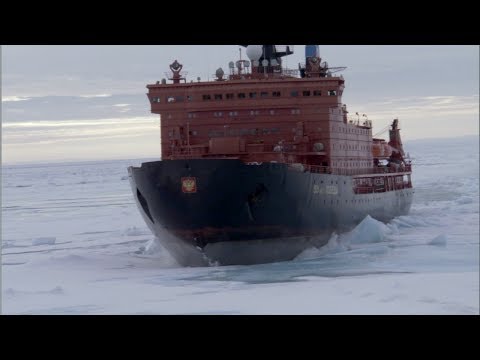
Russia plans to reach this goal by beefing up its fleet of nuclear icebreakers – the only such fleet on earth – produced by state nuclear giant Rosatom. The company is now building eight new models that should become operational within 2030.
Putin has claimed that about one-tenth of all Russian investments are allocated to the Arctic region, but given the scale of Moscow’s ambition, that is only a drop in the bucket. To realize a series of industry and infrastructure milestones, Moscow needs to attract as much as US$143 billion in private investments to the region over the next 10 years.
To do so, Moscow is considering offering two thirds tax exemptions to investing companies.
Amid poor relations with the West and confrontation with the US, Russia is looking to China as the key partner. In 2016, the Chinese government provided a $12 billion loan to help Russian gas giant Novatek, which had been battered by Western sanctions, to launch an ambitious liquefied natural gas plant in Siberia’s Yamal Peninsula.
Since operations started in late 2017, the Yamal LNG plant has been shipping liquefied gas to Europe and Asia through the NRS. Another plant, Arctic LNG 2, is expected to start activity in 2023 with Chinese participation.
According to a policy paper published last year, China is interested in integrating the Northern Sea Route into its globe-spanning Belt and Road Initiative.
However, the competition to control the Arctic and its resources risk turning the region into a hotbed of military confrontation.
Ice-cold war?
Russia has been upgrading Soviet-era military bases along the NSR, installing air defense systems and anti-ship missile launchers. Moscow’s Northern Fleet – the largest among Russia’s four fleets – has been fully modernized and exercises regularly in the region.
The US is also an Arctic nation and as Pompeo indicated at the Arctic Council, the US won’t leave Russia’s claims in the region unchallenged. Washington is already planning to expand related Coast Guard operations and ramp up its icebreaker fleet.
NATO has also been monitoring Russia’s military build-up and last year the alliance tested Arctic combat capabilities during Trident Junction military drills in northern Norway. This year, it’s Russia’s turn with the Tsentr-2019 war games that take place in the Arctic archipelago of Novaya Zemlya.
According to Russian military analyst Pavel Felgenhauer, risks abound in the NSR.
“It is typical for Russia to set its own rules, which means interpreting the rules of international navigation in its favor, and then punish others for non-compliance with these rules,” he said.
Felgenhauer drew a parallel with Russia’s recent actions in the Sea of Azov, where last November transiting Ukrainian vessels were seized by the Russian military for allegedly violating Russia’s national waters.
But conflict is not inevitable. Mikaa Mered, professor of Arctic and Antarctic geopolitics at the ILERI School of International Relations, believes the chances of a military confrontation between Russia and the US in the Arctic are close to zero. Mered points out that most Arctic resources are clearly located within the undisputed economic zones of the respective Arctic countries, reducing risks of a resource war.
And both Washington and Moscow seek regional stability. “Neither the US nor Russia have an interest in creating security risks in the Arctic that would drive investors away,” Mered told Asia Times.

I do agree with all the ideas you have presented in your post. They are really convincing and will definitely work. Still, the posts are too short for newbies. Could you please extend them a bit from next time? Thanks for the post.
The Phlippines is blessed with such a beautiful land and amazingly warm people. I always love coming back to the Philippines every year.
Hi! Do you know if they make any plugins to assist with SEO? I’m trying to get my blog to rank for some targeted keywords but I’m not seeing very good success. If you know of any please share. Kudos!
I have been browsing online more than three hours today, yet I never found any interesting article like yours. It’s pretty worth enough for me. In my view, if all website owners and bloggers made good content as you did, the net will be a lot more useful than ever before.
Amazing post.Nice work.Keep up the fine work. vuphespuzij7drl4ospo
Hey! Quick question that’s entirely off topic. Do you know how to make your site mobile friendly? My website looks weird when viewing from my iphone4. I’m trying to find a template or plugin that might be able to fix this problem. If you have any recommendations, please share. Cheers!
I like this post, enjoyed this one thank you for posting. “To affect the quality of the day that is the art of life.” by Henry David Thoreau.
Perfectly written content material, Really enjoyed examining.
Video games take too much time of our live ! https://japook.com
I have learn several excellent stuff here. Certainly worth bookmarking for revisiting. I wonder how so much effort you place to make this sort of great informative web site.
Really enjoyed this blog post, can you make it so I get an update sent in an email every time you make a fresh post?
Good day! I know this is kind of off topic but I was wondering if you knew where I could locate a captcha plugin for my comment form? I’m using the same blog platform as yours and I’m having difficulty finding one? Thanks a lot!
I loved as much as you will receive carried out right here. The sketch is attractive, your authored material stylish. nonetheless, you command get bought an impatience over that you wish be delivering the following. unwell unquestionably come further formerly again since exactly the same nearly very often inside case you shield this increase.
Write more, thats all I have to say. Literally, it seems as though you relied on the video to make your point. You definitely know what youre talking about, why waste your intelligence on just posting videos to your blog when you could be giving us something enlightening to read?
I do consider all the ideas you’ve offered on your post. They are very convincing and will definitely work. Nonetheless, the posts are very brief for novices. May just you please lengthen them a bit from next time? Thanks for the post.
Somebody essentially help to make seriously articles I would state. This is the very first time I frequented your website page and thus far? I amazed with the research you made to make this particular publish extraordinary. Excellent job!
Thanks for every other excellent post. The place else could anyone get that type of information in such an ideal way of writing? I have a presentation subsequent week, and I am on the look for such info.
Love this all new LCD Screens !
Good and interesting article to read.I got the useful information what I needed. vuphespuzij7drl4ospo
Bes Personal computer you can get is here ! https://japook.com