


China has been warned by the United States to dismantle its missile systems shield deployed in the disputed Spratly Islands chain in the South China Sea.
The move, believed to be the first time Washington has directly addressed the issue, came in a statement following high-level talks at last week’s second annual US-China Diplomatic and Security Dialogue.
Trade war tensions were expected to dominate the meetings in Washington.
But it was the military buildup in the South China Sea which was brought into sharp focus during discussions between US Secretary of State Mike Pompeo, Secretary of Defense Jim Mattis and their opposite numbers, Beijing’s leading diplomat Yang Jiechi and Defense Minister General Wei Fenghe.
“The United States called on China to withdraw its missile systems from disputed features in the Spratly Islands, and reaffirmed that all countries should avoid addressing disputes through coercion or intimidation,” the US statement said.
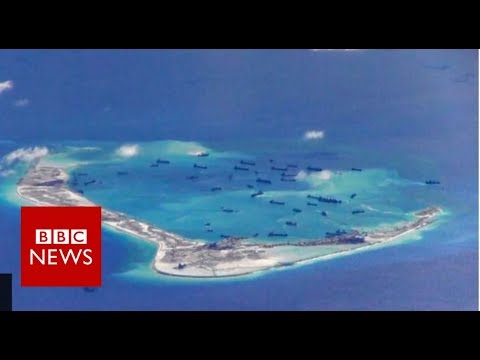
Concerns have been growing among Southeast Asian nations and Washington that China was slowly establishing an air defense zone around previously uninhabited islands, reefs and atolls in one of the world’s most important sea lanes.
US and allies
Military bases have been constructed as Beijing flouts international law, claiming the islands are integral parts of China.
The US and its allies have been told by President Xi Jinping’s administration to stop sending ships and aircraft near what the world’s second-largest economy considers to be sovereign territory.
In response, Mattis has made it clear that the US will “fly, sail and operate wherever international law allows.”
During the past year, the US and its allies have conducted maneuvers in the South China Sea, which is vital for global trade with goods and products worth between US$3 trillion and $5 trillion passing through vital sea routes.
“The Chinese side made it clear to the United States that it should stop sending its vessels and military aircraft close to Chinese islands and reefs and stop actions that undermine Chinese authority and security interests,” Senior Foreign Policy adviser Yang said.
Back in June at the Shangri-La Dialogue summit in Singapore, Mattis told defense ministers from 28 Asia-Pacific nations about the threat of “militarization” on former barren islands and reefs.
Outlining the problems faced by China’s naval and missile presence in their own backyard, he raised the question of “intimidation and coercion.”
“China’s militarization of artificial features in the South China Sea includes the deployment of anti-ship missiles, surface-to-air missiles, electronic jammers, and more recently, the landing of bomber aircraft at Woody Island,” Mattis said at the time.
“Despite China’s claims to the contrary, the placement of these weapons systems is tied directly to military use for the purposes of intimidation and coercion,” he added.
Opening gambit
Yet this is just the opening gambit, according to Patrick G Buchan, who specializes in Indo-Pacific security at the Center for Strategic and International Studies.
He stressed that China has a long-term strategy and is looking to become the “paramount power” in the region.
“China talks up a big game and understands the value of perpetrating a mythology of its inevitable dominance. It is an attractive and reasonably plausible message. But in this context, it is important to understand China’s endgame – to be the Indo-Pacific’s paramount political, military and economic power,” Buchan said.
“Essentially, China seeks to ease the United States out of the door, deadbolt it, and make sure it doesn’t come back. To this end, China is utilizing all the tools in the statecraft toolkit,” he continued.
“It deploys anti-ship and surface-to-air missile systems on its artificial islands, bullies the United States and allied ships on the high seas, splashes around cheap money, and dictates to foreign airlines how they should refer to Taiwan,” he said. “Across much of the Indo-Pacific, China currently sets the tone of the game. Critically, the United States does not,” Buchan added.

china dont even respect international law as in the case of philippines EEZ, china is a rougue country,
No internarional body recognizes china 9 dash crap
No internarional body recognizes china 9 dash crap
The big question in my mind is,WHY did you (USA) allow China to build those facilities? You should stopped them much earlier when China was just trying to occupy and build those artificial islands (cum military fortresses). Now you appear as the aggressor instead of the defender of the free world.
The big question in my mind is,WHY did you (USA) allow China to build those facilities? You should stopped them much earlier when China was just trying to occupy and build those artificial islands (cum military fortresses). Now you appear as the aggressor instead of the defender of the free world.
Robert Li and chinas pride was all copy cat and tested in actual battle. wooow amazing bluff of chinese fake master.
Robert Li and chinas pride was all copy cat and tested in actual battle. wooow amazing bluff of chinese fake master.
Joeseph Stalin nice commie name. Too embarrassed to be identified? You’re proof that you can’t teach stupid
Joeseph Stalin nice commie name. Too embarrassed to be identified? You’re proof that you can’t teach stupid
Notice, the warning is there. CommChi can always ignore the warning. We’re thankful before that Nikita Kruschev heed the warning then dismantle what he’d installed in Cuba. Being so arroganr and cunning, the ComnChise should not do anything but completely disregard any US warning. This way, Xi Jinping, can prove to the whole world that he is not ‘President-for-Life’ for nothing.
Notice, the warning is there. CommChi can always ignore the warning. We’re thankful before that Nikita Kruschev heed the warning then dismantle what he’d installed in Cuba. Being so arroganr and cunning, the ComnChise should not do anything but completely disregard any US warning. This way, Xi Jinping, can prove to the whole world that he is not ‘President-for-Life’ for nothing.
Why?China should increase it’s credibility!America-Israel-India are the real problem for the globe!
Why?China should increase it’s credibility!America-Israel-India are the real problem for the globe!
Sad to say Irvin US has weakened. They could have done that twovtrs ago when China started building it A sad reality
Sad to say Irvin US has weakened. They could have done that twovtrs ago when China started building it A sad reality
Robert Li s2pid
Robert Li s2pid
Yashad Rizvi That’s what your mother said about father and other men. hahahah
Yashad Rizvi That’s what your mother said about father and other men. hahahah
It’s also important to know the US endgame in middleast with the resultant cost and absolutely no benefit at all to the rest of the world just death and destruction. Duterte just told the US to shove it and the Thais, Malaysia and Indonesia are not exactly too enamoured with US , the rest of ASEAN are looking for leadership and even Singapore the usual US spokesman aren’t too sure about the US presence agitating for a war. Japan’s Abe has made it across to China for trade. RCEP is ongoing and slated for ratification by member countries by 2019. The US defence industries loves it when the war happens in a faraway land. They stay safe, not have to deal with refugees and they get to sell weapons.