


Asia spent the last 22 months fearing Donald Trump’s angry Twitter feed. Turns out, it’s the United States president’s hologram that poses the biggest risk to the most dynamic economic region.
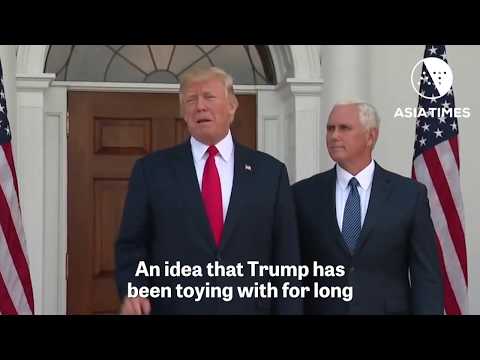
The three-dimensional projection in question is Mike Pence, Trump’s vice-president. In two speeches spread 44 days apart, Pence gave up America’s Asia game plan for 2019. And it won’t be pretty for policymakers, markets or investors in the most dynamic economic region.
On October 4 in Washington and October 17 in Papua New Guinea, Pence channeled “teleprompter Trump,” those rare moments when his boss sticks to script and spells out a specific policy. Divining one on China trade has been near impossible.
When Trump talks of China, Japan and Southeast Asia, it’s a word salad of resentment, fantasy and paranoia that drives translators batty. Teleprompter Trump sounds like something approaching a traditional American leader.
Pence played that role well enough at recent summits of the Association of Southeast Asian Nations and Asia-Pacific Economic Cooperation forum. What can Asia investors now conclude? Three things.
Misunderstanding
One is that US$505 billion worth of tariffs are coming. Trump has been teasing the idea of doubling the $250 billion worth of levies on Chinese goods.
Depending on the day, it’s been hard to discern where the odds lie. Trump often contradicts himself in the same interview – at once saying a deal with Xi Jinping is possible, at other moments telegraphing more tariffs.
Trump’s misunderstanding of trade leads him to believe that the $505 billion of goods China sent to the US in 2017 means Beijing ripped off American workers by that same amount. Hardly.
Still, Pence’s October 4 “we-will-not-stand-down” China speech suggested 2019 could get even worse for Beijing. His November 17 comments – “The US will not change course until China changes its ways” – came with fresh warnings of new taxes on Chinese goods.
Pence’s words suggest there will be no Trump 2.0 doctrine following the beating the Republican Party took in November 6 midterm elections. Instead, expect the White House to double down on a trade war it thinks is working.
Pence’s assurance that “we’re here to stay” could mean a brutal 2019 for Asian stocks, export growth and epic volatility in currency markets.
One of Trump’s biggest missteps on the world stage was believing President Xi Jinping, a fellow nationalist strongman, would buckle. Just as Trump maintaining his base requires him looking resolute, Xi’s legitimacy in Communist Party circles relies on projecting Chinese strength.
Bowing to the hate-tweeter-in-chief isn’t an option for a Chinese president aiming to be in office long after the Trump era.
Cold War
Then, there is the second issue – China will retaliate. So far, Xi’s team has pulled punches in its responses. As Xi put it on November 17, “confrontation, whether in the form of a hot war, cold war or trade war, will produce no winners.”
Yet as Trump digs in for greater confrontation, Xi is under pressure to return fire. And Beijing has a rich selection of weapons.
China could start dumping its $1.2 trillion of Treasury debt holdings, slamming the dollar and sending US interest rates skyrocketing. Sure, it would be a Pyrrhic victory. Any step that reduces the spending power of US consumers is bad for China’s ability to grow at 6.5%. It would surely get Trump’s attention, though.
Xi’s government could begin imposing exit taxes on US goods made in China. That would surely ruin Apple’s year. Beijing could make it harder for Chinese tourists to visit America and slow the flow of students dropping tens of thousands of dollars a year at US universities.
It could clamp down on work visas for American executives and corporate licenses.
What’s to stop Beijing from doing surprise tax audits, inspections of US airlines, hotels, restaurants and adding new logistics bottlenecks that halt the flow of vital supplies? Trademarks could be revoked, or new taxes imposed. Capital controls could be imposed to impede the operations of US investment banks on the mainland.
Big question
Finally, there is issue number three – Asia picking sides could roil markets.
At last week’s ASEAN summit, Singapore’s Prime Minister Lee Hsien Loong asked the question on the mind of every Asian leader: What to do when they’re forced to choose between Trump’s America and Xi’s China? This is, after all, a when, not an if, and 2019 is the year decisions are due.
Shinzo Abe’s Japan long ago chose Trump, while Rodrigo Duterte’s Philippines has pivoted in Xi’s direction. Elsewhere in the region, leaders are weighing how to co-exist with two leaders who really know how to hold a grudge – and exact pain.
Just ask South Korea, which is still dealing with the fallout from Xi’s wrath for hosting US-built missile-defense systems. Or Mahathir Mohamad’s Malaysia, which is keen to get out of China’s shadow but loath to embrace the Trump White House. Good luck with that balancing act.
As these deliberations leak into the press, Asian leaders risk irking Xi, Trump or perhaps both. The resulting tensions – strains Pence suggest will only intensify – could bleed into markets in unpredictable ways. Any new Trump tariffs would slam equities, bonds and currencies. Moves by Beijing to limit access to China’s middle class will reverberate far and wide.
One strategy is waiting out the Trump clock, betting that Americans elect a more rational, pro-trade leader come 2020. All bets are off if Trump wins a second term, giving us six more years (counting from now) of Trump versus Xi spooking markets.
As Pence, Trump’s hologram, reminds us, Asia hasn’t seen anything yet.

An even better response from Xinhua
http://www.xinhuanet.com/english/2018-11/20/c_137620257.htm
An even better response from Xinhua
http://www.xinhuanet.com/english/2018-11/20/c_137620257.htm
There is no evidence of such a policy, but in the course of its social and economic development, China’s influence is growing worldwide. This, combined with Trump’s retrograde policies, tends to erode the influence of the US. People simply begin to compare the US unfavorably to China.
The nightmare for the establishment in the West, and the US in particular, is that such thinking may come to infect their populations. Hence, the developing hysteria about Chinese "influence".
There is no evidence of such a policy, but in the course of its social and economic development, China’s influence is growing worldwide. This, combined with Trump’s retrograde policies, tends to erode the influence of the US. People simply begin to compare the US unfavorably to China.
The nightmare for the establishment in the West, and the US in particular, is that such thinking may come to infect their populations. Hence, the developing hysteria about Chinese "influence".
Countries like Pakistan and Srilanka are already burdened with foreign loans before BRI and can’t easily obtain further loans for development.
BRI development projects are arrived at mutually and funded with aid of soft loans. Debt crisis is mainly caused by legacy loans from past. Some institutions like the IMF may use a debt crisis to lever open domestic market or let foreign money pick up bankrupt local companies at fire sale prices. BRI alternative loans are not welcome especially where it can uplift developing countries from cheap labor or mere commodity producers.
Countries like Pakistan and Srilanka are already burdened with foreign loans before BRI and can’t easily obtain further loans for development.
BRI development projects are arrived at mutually and funded with aid of soft loans. Debt crisis is mainly caused by legacy loans from past. Some institutions like the IMF may use a debt crisis to lever open domestic market or let foreign money pick up bankrupt local companies at fire sale prices. BRI alternative loans are not welcome especially where it can uplift developing countries from cheap labor or mere commodity producers.
more anti Trump schillery.
more anti Trump schillery.
The author and commenters are too dense to see that Trump’s China policy is based on China’s policy of marginalizing the United States.
The author and commenters are too dense to see that Trump’s China policy is based on China’s policy of marginalizing the United States.
Yes, Trump, the liar – in – chief and his gang will double down on his lying about trade and China.
Yes, Trump, the liar – in – chief and his gang will double down on his lying about trade and China.
Been through Korea war and Vietnam war with the US I am sure China is soooo scare.
"Trump’s hologram" Rarely does the US VP speaks for the PotUS. Pence is on a loose lease with his own agendas campaigning either for his next election or betting Trump will be impeached. So it’s just barking and puffing smoke. Drama, Drama and more Dramas in the WH soon.
China has sent a list of proposals. That is as good as it is going to be. USA should accept gracefully, clam up and start putting its own house in order.
This is not a poker game at all!
China has sent a list of proposals. That is as good as it is going to be. USA should accept gracefully, clam up and start putting its own house in order.
This is not a poker game at all!
All indications are that ASEAN just hopes Trump and the US would go away and stop trying to create chaos in the region where everyone is enjoying steady growth as part of China’s economic engine. There are no reports that his writer has seen that Pence’s message was welcome, just as it wasn’t in Seoul during the Olympics.
There is a kind of recklessness in the actions of the US these days, one that betrays a sense that its influence is slipping and has no answer but aircraft carriers and bluster.
With the kind of disruption the US is creating in the region, perhaps China doesn’t have to do anything. There are plenty of others who are being hurt who can pile on political pressure on Trump. We’ll see.
All indications are that ASEAN just hopes Trump and the US would go away and stop trying to create chaos in the region where everyone is enjoying steady growth as part of China’s economic engine. There are no reports that his writer has seen that Pence’s message was welcome, just as it wasn’t in Seoul during the Olympics.
There is a kind of recklessness in the actions of the US these days, one that betrays a sense that its influence is slipping and has no answer but aircraft carriers and bluster.
With the kind of disruption the US is creating in the region, perhaps China doesn’t have to do anything. There are plenty of others who are being hurt who can pile on political pressure on Trump. We’ll see.
People in this World as well as Americans are already used to Mr Trump’s brinkmanship. He double-downs on trade-war and his chance of a second term will double down as well, which is already not much left now…
People in this World as well as Americans are already used to Mr Trump’s brinkmanship. He double-downs on trade-war and his chance of a second term will double down as well, which is already not much left now…