


Mystery continues about the strange visit by CIA Director John Ratcliffe to Moscow, flying there in a massive C-17 Globemaster, a military airlifter.
While the Globemaster has a specially designed secure roll off and roll on module for top officials, keeping them harnessed to Washington and the President, the choice of aircraft, instead of a much smaller VIP aircraft, helps us understand this was a highly sensitive but visible, urgent mission.
Rumors are swirling all over Europe that the Russians are planning to attack some NATO members. Lithuania has been mentioned. The rumors are not in a vacuum and don’t depend on statements by Russian leaders, especially their anger with the UK sending long range drones and cruise missiles for Ukraine to attack Russian territory.
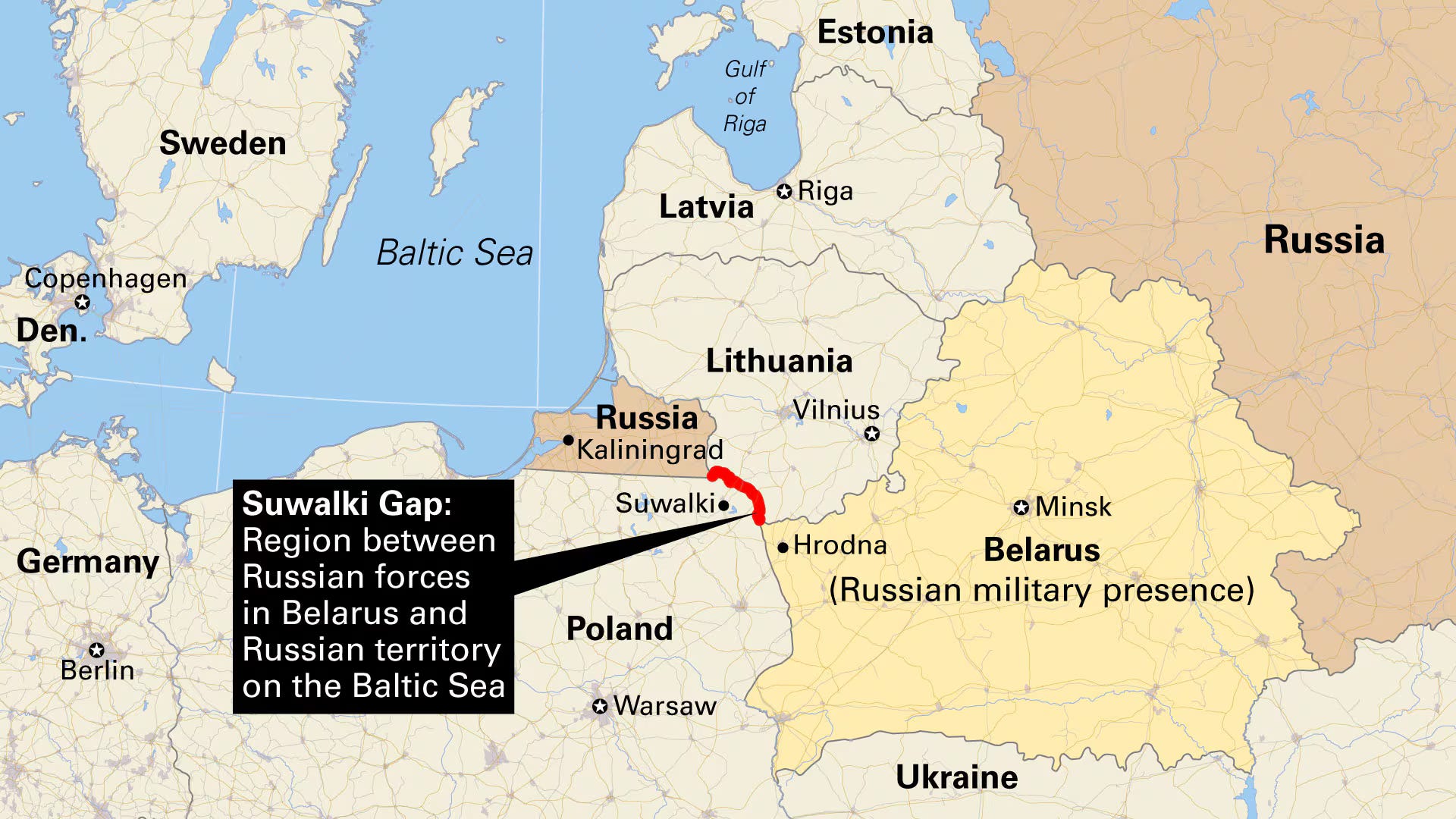
The immediate focus is Kaliningrad. Kaliningrad, back when it was part of Prussia, was known as Konigsberg. It is a strategic Russian enclave on the Baltic Sea, but it is not physically connected to Russian territory or to Russian controlled lands. It was awarded to Russia in 1945 at Potsdam as part of the postwar settlement.
During the Cold War, Kaliningrad was surrounded by communist Poland and communist Lithuania, both then Warsaw pact members. But today both Poland and Lithuania are independent, NATO members and significantly hostile to Russia.
For Russia to support Kaliningrad it relies on land and rail access from Belarus across the Suwalki corridor, which has been recently fraught by attempted blockages and closures initiated by Poland and Lithuania. Kaliningrad can also be supported by sea, but the Russians have lost significant leverage in the Baltic, especially after once-neutral Sweden and Finland joined NATO.
Kaliningrad also has an air terminal that appears well defended by air defense systems including the S-400 air and missile defense system, and Pantsir which is a short range system useful for knocking down drones and cruise missiles.
Recently a heavy concentration of specialized NATO aircraft are operating in international airspace near Kaliningrad, a clearly provocative move by NATO.
The deployment featured a simultaneous flight of E-3 AWACS airborne early warning and control planes, an American EA-37B Compass Call II electronic warfare aircraft, an ARTEMIS II reconnaissance platform and American, Norwegian and Polish fighter units.
The advanced EA-37B is a powerful intelligence-gathering and electronic warfare platform, suggesting preparations for a NATO strike launched at Kaliningrad.

Responding to the NATO operations, Russia’s Baltic Fleet has conducted tactical air-defense exercises simulating enemy air raids against the Baltiysk naval base. These drills involved Su-30 multirole fighters, Mi-24 combat helicopters and unmanned aerial vehicles acting as hostile elements.
The Baltiysk Naval Base is situated on the Vistula Spit, Russia’s main ice-free base on the Baltic. It includes surface combatants, diesel-electric submarines, naval aviation, and coastal defense missile systems (such as the Bastion and Bal systems) designed to project power across the Baltic approaches and enforce anti-access/area-denial (A2/AD) coverage over neighboring NATO airspace.
These mutual operations have raised tension levels very high between NATO and Russia. While the US has supported the military operation around Kaliningrad, Washington also is concerned that there is a growing risk that actual fighting could break out that might involve Russian attacks on Poland and Lithuania – or, even farther back, NATO bases in Germany and the UK.
There is no public evidence beyond what has been seen around Baltiysk, but there is growing preparation by the Russians including moving nuclear weapons to Belarus. At the tail end of August (27 to 29) Belarusian President Alexander Lukashenko held a working meeting with Russian Prime Minister Mikhail Mishustin in Moscow, followed by official talks with President Vladimir Putin at his Novo-Ogaryovo residence outside Moscow. The Kyiv Post reported that the Lukashenko-Putin meeting focused on security coordination and strategic cooperation.
Neither NATO, the US nor the Russians have reported any troop movements related to the Baltics or Eastern Europe. While NATO claims the Russians are preparing a major mobilization, the Russians deny that, and even the Ukrainians, including the GUR (military intelligence) do not think that is the case.
There have been a number of other provocations such as attacks on manufacturing and supply facilities in Italy, Bulgaria, Estonia and Slovakia, alongside a thwarted attack involving an explosives-packed drone discovered near a cargo plane at Leipzig/Halle Airport in Germany.
Similarly there have been a number of disruptions of underseas cables in the Baltic Sea and elsewhere, attributed by NATO to operations conducted by the Russia-backed “shadow fleet” of tankers and container ships. While not all the provocations were of Russian origin, there is a growing list of incidents that point back to Moscow.
Underlying all the military activity, there is a growing sense that the Ukraine war is reaching a crisis moment. Kyrylo Budanov, the former head of Ukraine’s military intelligence (GUR) and now advisor to Zelensky, recently said that Ukraine cannot afford not to mobilize at least 30,000 personnel per month just to maintain its current defensive capabilities and force structure on the front lines.
In other words, Ukraine is losing up to 30,000 front line soldiers each month and cannot replace them. While Russian losses no doubt are also high, the Russians have a large pool of active duty soldiers available, although there are rumors that young people are leaving Russia to avoid a bigger mobilization.
But young people cannot leave Ukraine, and there are fewer and fewer willing to go to war, leaving Ukraine in a crisis. Recently the Ukrainians are talking about drafting large numbers of women for combat duties.
That manpower crisis is compounded by the short supply of critical weapons, so much so that Ukraine’s artillery lacks ammunition and artillery tubes and weapons are in short supply. Milbloggers (including Ukrainians) also report field shortages of drones, which Ukraine uses in massive numbers.
Compounding the mess, key air defense systems and interceptors, especially Patriot, have practically disappeared. The Russians carried out a deadly attack on August 29 in the Bucha district west of Kyiv that destroyed a warehouse where some of the few remaining Patriots and other weapons were stored.
The ammunition in the warehouse in a civilian district exploded, killing 37 people (perhaps more), and that sparked a political crisis in Ukraine as it became clear that the Ukrainian army was hiding ammunition in populated areas.
The attack was bad enough that President Zelensky accepted responsibility and launched an investigation.

Recalling that Zelensky recently fired his defense minister – as well as his army commander, Oleksandr Syrsky – it is not clear how much longer the Ukrainians can stay in the fight.
From a strategic point of view this raises the question of whether NATO can come to the rescue, but doing so would require a consensus that does not currently exist, and a military capability that is weak and ill equipped and poorly supported.
For the US, which no longer considers itself to be a key backer of Ukraine and is increasingly wobbly on NATO, a war in Europe would be a political and military disaster, and physical involvement in Ukraine would be just as bad.
Like Ukraine, the US is very short on warfighting material including air defense systems, ammunition, and smart weapons.
In the past year or longer, US intelligence (based mostly on UK and NATO assessments) focused on the idea of damaging Russia enough to force Putin and his army out of the war. That explains the drone war against Russia, along with sabotage operations deep inside Russian territory, and multiple assassinations, especially of Russian military officers.
But the CIA-MI6-NATO strategy, backed by a major propaganda effort, seems to have fallen short of its goal. There is little or no evidence that Russia is ready to make major concessions or to pull out of Ukraine.
It is interesting that Elon Musk has refused the use of his Starlink system for Ukrainian strikes on Russian territory, explaining that Musk could not see how these attacks would bring an end to the war.
The fact that now the propaganda has shifted to the Russian “threat to Europe” suggests that US and NATO intelligence are trying to jack up support to continue the war in Ukraine in order to avoid a bigger war in Europe. While the logic here is, sadly, murky, it represents a growing angst that Ukraine is about to implode.
In the midst of all this, and arriving on a huge military transport, CIA Director Ratcliffe apparently hoped to speak directly to Putin. But Putin was not ready for any meeting and left it to the head of the SVR (Russia’s Foreign Intelligence Service), Ratcliffe’s opposite number, Sergey Naryshkin. The message from Ratcliffe was a proposal of how to end the Ukraine war.
Various reports claim to be authoritative, but none report directly from the meeting in Moscow, which may have lasted eight or nine hours. If Ratcliffe just wanted a ceasefire, or for Russia to pull out of Ukraine, that would take ten minutes of his time and ten minutes for translation. Even the Russian reply could have been brief. But the long meeting implies a lot more was on the table.
The Ukrainians, who have back channels to the Russians (after all, their service was created by Russia and trained over the years by Russian operatives), say that the US offered to pull all US troops out of Europe in exchange for freezing the war in Ukraine.
If the Ukrainian report is true, it would open the door to a wide-ranging discussion between the US and Russia. Getting the US out of NATO would be a major Russian victory, an historic one since NATO grew out of the Cold War.
On July 1, 1991, in Prague the Warsaw Pact was officially disbanded after 36 years (founded in 1955). It was Russia’s answer to NATO (founded in 1949). Unlike the disbanding of the Warsaw Pact, and no longer facing an opposing alliance, NATO began a huge territorial expansion, which the Russians saw, and still regard, as threatening.
Of course, pulling US troops out of Europe would not end US participation in NATO, but it would be a huge strategic shift. Russia’s focus, as far as it can be understood, is to avoid being surrounded by hostile states, backed by the US. So if this was the offer by the US side, it was highly significant.
But what does “freezing” the war in Ukraine mean in practical terms? The Russians are skeptical that Zelensky would accept a real freeze, and Russia believes Zelensky will agree only to a time-limited ceasefire under which he could rebuild his army and recruit adequate manpower.
Some reports indicate that the Russians may have suggested removing the Zelensky government completely and replacing it with an internationally backed administration for Ukraine. Such a government might pave the way for the two adversaries to reconcile differences and sort out territorial, military, political and cultural conflicts.
With Europe’s current crop of political leaders and their strong commitment to Zelensky, any deal as discussed in Moscow would fail to get support in Europe. However, European leadership is on the cusp of change in the UK, France and Germany (perhaps also Italy), meaning that a new crop of European leaders may take a more flexible approach in future.
At the same time, the US commitment to NATO has increasingly wobbly support in Washington, where there is no desire to keep supporting Ukraine or backing up the alliance. The White House unhappiness with the European response on Iran has simply made things worse.
It isn’t clear whether Ratcliffe’s mission has changed anything, but it may have set in motion a process that could help end the Ukraine conflict.
Stephen Bryen is a former US deputy under secretary of defense. You can read this article and many more in his newsletter Weapons and Strategy.

“Some reports indicate that the Russians may have suggested removing the Zelensky government completely and …”! That would be a great help.
Warm water {s}ports … Oy….
The Road to Hell is Paved with…
Small paving stones in your case ?
Feeling pain, again, eh?
“Hell is paved, saith one, with good intentions,” John Wesley sermon at Oxford University. The Dalit is a true illiterate baka Capon.
They can get big if you rub them, you know that!
A great deal ofvwishful thinking in this article. Nothing is set in motion of any value. Change in Europe not likely. The only meaningful change would be for Prussia to liberate itself — but whle there are votes for it — There is no Bismarck. That would solve the East European dilemma, leaving West Europe to decide what to do when it grows out of its colonial mindset.
Prussia ? It ceased to exist in 1945. Berlin is not Prussia, it is Brandenburg.
What are you talking about ‘colonial mindset’, that is Russia in Siberia
Imperialism is Imperialism …Russia’s Window on West still has currency, bogus or not …
Article is speculative based upon seems few detail confirms. US withdrawal from Europe in exchange for end to Russia/Ukrania war? Interesting offer, if true …What is/might be Rus/ukran reply?
Trump running out of his standard “this is how you deal with Rusdians” play book trick. Good old combo of insults, bribes, thrests, and tricks. Itbis time to go back to “”imprress stupid Russians”. Invite to G 20 meetings, Then do not offer lunch, Alaska trick. Nothing has changed. Freezing the conflict is the call for Russia’s capitulation. While iffering nothing — apisolutelly nothing. Same old — flatter Russians, then humiliate. Western mentality, Trumo’s in particular do not understsnd Russian turn another cheek. Kissing three times, same as crossing a road. Look left, right — then left again.
The hardest part of a 3wk SMO is the first 4yrs. Russia is toast.
Not if you close your mouth and open your effing eyes.
The “Warsaw Pact” founding date ploy is BS … Look at the signatories… Russian Marshalls, duly appointed administrators of lands conquered by the then red army… Interesting read …