


Sixty five years after the guns fell silent in Korea, the ashes of veteran William Speakman were lowered into the ground on Tuesday at the United Nations Cemetery in Busan, South Korea.
Under grey skies, it was a poignant ceremony. Young men killed in combat are customarily buried in the soil on which they fight, but it is a rarity for old soldiers to be interred in distant battlegrounds – particularly Western troops who fought in the Asian wars of the 20th century.
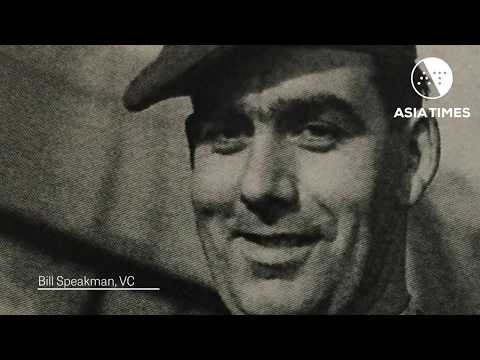
But Briton Speakman, who passed away in June 2018, had demanded he be buried in South Korea. And he was no ordinary soldier.
Slaughterground: Hill 217
His early military career had not been promising. Too young to fight in World War II, stationed in Germany, Italy and Hong Kong, “Big Bill” – so named for his six-foot-six height – had often been in trouble for drinking and brawling. Keen to depart barrack for battlefield, he volunteered for Korea, where war had been raging since North Korean invaded South on 25 June 1950.
It was in Korea, on 4 November 1951, on the frozen slopes of Hill 217, that he achieved nobility.
Speakman was assigned to the King’s Own Scottish Borderers, a British infantry battalion fighting under the United Nations Command, the US-led multinational force assisting South Korea against, first, North Korea invasion, and subsequently, Chinese intervention. By November 1951, the war had become a meat-grinder: A hideous struggle for barren hills along what would subsequently become the Demilitarized Zone, or DMZ.

Hill 217 was one of those strategic sites. On November 4, Chinese artillery began to thunder down: “It started boiling that afternoon,” Speakman recalled in conversations with this writer in 2015. Some 6,000 shells churned up the KOSB positions. The terrain was cratered, trenches collapsed and huge palls of dust spread across the darkening sky.
The storm of high explosive and whirling steel was just preparation. In late afternoon, thousands of Chinese infantry stormed the positions held by the 600 Scots.
Speakman was in the rear, tasked with priming crates of grenades. As radio reports came in of position after position being swamped, Speakman stood. Asked what he was doing, he replied – in the harsh frontline argot of the time – “I’m going to shift some of those bloody Chinks.”
He acted without orders. “We had to get the wounded off the hill: that was big for me, while I was able bodied, I had to get them down,” he recalled. “I felt the need to do my little bit.”
“My little bit.” It is difficult to imagine the nightmare scenes that unfolded on the rocky contours of Hill 217 as evening fell and as Speakman single-handedly charged up the hill into the midst of the enemy troops swarming over the strongpoint.
Aimed fire was impossible, he remembered; there were too many enemy, and no time to work the bolt of a rifle. Instead, Speakman had filled his pockets and pouches with the grenades. These became the primary weapon in the close-range maelstrom the former bar brawler became embroiled in. The soil was frozen solid, so when Speakman volleyed his bombs, they bounced and detonated in the air, creating a wider spread of shrapnel, and inflicting greater casualties, than if they had burst on the ground.
Other men, inspired, joined Speakman as he made repeated attacks, returning to the lower slopes only to obtain more grenades. Wounded in the shoulder and leg, he had to be ordered to receive field dressings. Then he continued attacking. Along Hill 217’s ridges, the bodies literally piled up.
Some would later attribute Speakman’s berserk fury to drunkenness. A legend arose that when he ran out of grenades, he hurled beer bottles at the enemy. He angrily denied both rumors. “Take it from me: No beer bottle was thrown – our business was to fight, not drink!” he said.

Victoria Cross
Given the whirlwind confusion and trauma of the night’s battle, it is unsurprising that Speakman could explain little about it and recalled few details, even though he fought for a remarkable six hours: His first post-battle memory was waking in hospital in Japan. He was subsequently awarded the Victoria Cross – the highest award for gallantry in battle that the UK can bestow.
Although more Britons were killed in Korea than in the Falklands, Iraq and Afghan conflicts combined, just four VCs were awarded in the three-year war. One went to Colonel James Carne, commander of the “Glorious Glosters,” a battalion that was annihilated after a desperate three-day stand against a Chinese division.
Two were posthumous. Both were granted to soldiers taking part in actions very similar to Speakman’s.
Major Kenny Muir of the Argyll and Sutherland Highlanders won his when, after his battalion had been mistakenly napalm bombed by the US Air Force, he led 12 men to hold off counter-attacking North Korean troops. He was killed directing a last-ditch defence which won time for the smoking wounded to be evacuated. Lieutenant Philip Curtis of the Glosters won his by single-handedly taking out a Chinese position that had pinned down his overrun company, enabling survivors to escape. (In a tragic footnote, his men subsequently learned that Curtis had volunteered for Korea after losing his wife and baby in childbirth.)
War and peace
Uncomfortable with the fame of being the only living Korean War VC – Muir and Curtis were dead; Carne was in a POW camp – Speakman volunteered for a second tour in Korea. After that conflict wound down, he joined special forces and served in Malaya, hunting Chinese communists through the jungle.
But although he denied ever suffering from post-traumatic stress, he was a troubled man.
A heavy drinker, near the end of his two decades of military service, he was convicted of stealing. He married three times and divorced three times. Broke, he sold his VC to subsidize repairs to the roof of his house. (He would later obtain a replica.) He joined the Merchant Navy, and subsequently moved to South Africa, where he worked in security, before returning to the UK in his twilight years.
And he mellowed. He gave up drinking, and felt no hatred toward his former foes. “You can’t have enmity,” he said of the Chinese. “In this day and age, you have to get on with people, we are so cosmopolitan now, even in our own country. It’s nice to have them.”
Invited to visit Korea by the Ministry of Patriots and Veterans Affairs, he was amazed and moved at the progress the formerly war-shattered nation had achieved. An agrarian, peasant economy in the 1950s, South Korea was a high-tech powerhouse and thriving democracy by the millennium.
“They have made South Korea into a wonderful place,” Speakman would enthuse to a comrade, as recalled by British Ambassador to Korea Simon Smith. “It was worth it going over there. I really do love Korea and its people.”
On his last trip, in 2015, the craggy, wheelchair-bound warrior was photographed hugging Korean children. At a ceremony in his honor, he donated his medals (in fact replicas) to the Minister of Patriot’s and Veterans Affairs. “I decided before I died I would do something with this VC,” Speakman said. “Because it originated in South Korea, I thought it had to come back to South Korea.”
The set is today displayed at Seoul’s War Memorial.
‘Welcome back’
Four relatives accompanied Speakman’s ashes to Korea. They were greeted at Incheon International Airport by a South Korean honor guard and the Minister of Patriots’ and Veterans Affairs. A letter from President Moon Jae-in was read out.
In 2015, Speakman had asked to have his ashes scattered over the Imjin River, the strategic valley that ran through the war like a blood meridian; Hill 217, or Mount Maryang, today lies just miles north of it, in the DMZ. However, ash scatterings are illegal in South Korea. As a compromise, he was laid to rest at the UN Cemetery in Busan.
“His life changed here [in Korea] so it is only fitting that he lies here now,” his daughter Susie, one of the visiting relatives, told Asia Times. “It was Dad’s final wish, and it is great to see him on his way.”

His funeral was attended by local veterans, officers of the UN Command and diplomats. A piper’s lament was played and wreaths were laid by diplomats, ministers and generals A salute was fired as his ashes were lowered into the grave. .
“The most fitting place for him to be was with his former comrades,” said his son Caspar, referring to the 885 British soldiers buried in Busan – including fellow VC holders Curtis and Muir.

Local school children gave gifts to the Speakman family and laid wreaths. National media was in attendance and Speakman’s return did not escape the attention of netizens,
“RIP, sir,” wrote Sung-min Lee, a restaurateur and former soldier on a social media post. “And welcome back.”


Hello, after reading this awesome post i am too cheerful to share my knowledge here with colleagues.|
Just wish to say your article is as astonishing. The clearness on your publish is simply excellent and that i could think you’re an expert on this subject. Fine together with your permission allow me to seize your RSS feed to stay up to date with impending post. Thanks a million and please keep up the gratifying work.|
If some one wishes expert view on the topic of running a blog after
that i propose him/her to pay a quick visit this webpage, Keep up the nice job.
I could not refrain from commenting. Very well written!
I was very happy to discover this web site. I need to to thank you for ones time for this particularly
wonderful read!! I definitely savored every bit of it and I have you book-marked to look at new things on your web site.
I always emailed this web site post page to all my
contacts, as if like to read it afterward my contacts will too.
If you are going for best contents like I do, only pay a visit this web page every day since it offers quality contents, thanks|
I do not even know the way I stopped up right here, but I assumed this put up was once great. I do not recognize who you’re but certainly you are going to a well-known blogger in case you aren’t already. Cheers!|
Everything is very open with a precise clarification of the challenges. It was definitely informative. Your website is useful. Thanks for sharing!|
Way cool! Some very valid points! I appreciate you penning this post and the rest of the site is also very good.|
There is certainly a great deal to find out about this issue. I like all of the points you’ve made.|
Hi there! This blog post couldn’t be written any better! Looking through this post reminds me of my previous roommate! He constantly kept talking about this. I will forward this post to him. Pretty sure he’s going to have a good read. I appreciate you for sharing!|
Really when someone doesn’t be aware of then its up to other people that they will help, so here it happens.|
Great website. Lots of useful info here. I’m sending it to
a few buddies ans additionally sharing in delicious.
And certainly, thanks in your sweat!
Thanks for finally talking about > blog_title < Liked it!|
I am really enjoying the theme/design of your site. Do you ever run into any web browser compatibility issues? A few of my blog readers have complained about my blog not operating correctly in Explorer but looks great in Opera. Do you have any tips to help fix this problem?|
I do not know whether it’s just me or if everyone else experiencing issues with your website. It looks like some of the written text within your content are running off the screen. Can somebody else please comment and let me know if this is happening to them too? This might be a problem with my browser because I’ve had this happen before. Many thanks|
Hey there! This is my 1st comment here so I just wanted to give a quick shout out and tell you I truly enjoy reading your blog posts. Can you recommend any other blogs/websites/forums that go over the same subjects? Appreciate it!|
A lot of thanks for all your valuable effort on this web page. Kim loves participating in internet research and it is easy to see why. Almost all hear all of the lively ways you render very important solutions on this website and as well invigorate contribution from some others about this article then our princess has been studying a great deal. Take pleasure in the rest of the year. You are always doing a really good job.
It’s good to come across a blog every once in a while that isn’t the same unwanted rehashed information. Excellent read! I’ve saved your site and I’m adding your RSS feeds to my Google account.