


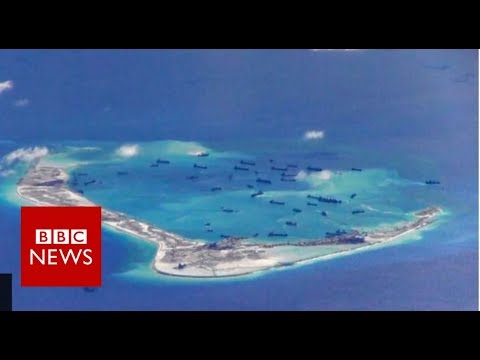
China has been warned by the United States to dismantle its missile systems shield deployed in the disputed Spratly Islands chain in the South China Sea.
The move, believed to be the first time Washington has directly addressed the issue, came in a statement following high-level talks at last week’s second annual US-China Diplomatic and Security Dialogue.
Trade war tensions were expected to dominate the meetings in Washington.
But it was the military buildup in the South China Sea which was brought into sharp focus during discussions between US Secretary of State Mike Pompeo, Secretary of Defense Jim Mattis and their opposite numbers, Beijing’s leading diplomat Yang Jiechi and Defense Minister General Wei Fenghe.
“The United States called on China to withdraw its missile systems from disputed features in the Spratly Islands, and reaffirmed that all countries should avoid addressing disputes through coercion or intimidation,” the US statement said.
Concerns have been growing among Southeast Asian nations and Washington that China was slowly establishing an air defense zone around previously uninhabited islands, reefs and atolls in one of the world’s most important sea lanes.
US and allies
Military bases have been constructed as Beijing flouts international law, claiming the islands are integral parts of China.
The US and its allies have been told by President Xi Jinping’s administration to stop sending ships and aircraft near what the world’s second-largest economy considers to be sovereign territory.
In response, Mattis has made it clear that the US will “fly, sail and operate wherever international law allows.”
During the past year, the US and its allies have conducted maneuvers in the South China Sea, which is vital for global trade with goods and products worth between US$3 trillion and $5 trillion passing through vital sea routes.
“The Chinese side made it clear to the United States that it should stop sending its vessels and military aircraft close to Chinese islands and reefs and stop actions that undermine Chinese authority and security interests,” Senior Foreign Policy adviser Yang said.
Back in June at the Shangri-La Dialogue summit in Singapore, Mattis told defense ministers from 28 Asia-Pacific nations about the threat of “militarization” on former barren islands and reefs.
Outlining the problems faced by China’s naval and missile presence in their own backyard, he raised the question of “intimidation and coercion.”
“China’s militarization of artificial features in the South China Sea includes the deployment of anti-ship missiles, surface-to-air missiles, electronic jammers, and more recently, the landing of bomber aircraft at Woody Island,” Mattis said at the time.
“Despite China’s claims to the contrary, the placement of these weapons systems is tied directly to military use for the purposes of intimidation and coercion,” he added.
Opening gambit
Yet this is just the opening gambit, according to Patrick G Buchan, who specializes in Indo-Pacific security at the Center for Strategic and International Studies.
He stressed that China has a long-term strategy and is looking to become the “paramount power” in the region.
“China talks up a big game and understands the value of perpetrating a mythology of its inevitable dominance. It is an attractive and reasonably plausible message. But in this context, it is important to understand China’s endgame – to be the Indo-Pacific’s paramount political, military and economic power,” Buchan said.
“Essentially, China seeks to ease the United States out of the door, deadbolt it, and make sure it doesn’t come back. To this end, China is utilizing all the tools in the statecraft toolkit,” he continued.
“It deploys anti-ship and surface-to-air missile systems on its artificial islands, bullies the United States and allied ships on the high seas, splashes around cheap money, and dictates to foreign airlines how they should refer to Taiwan,” he said. “Across much of the Indo-Pacific, China currently sets the tone of the game. Critically, the United States does not,” Buchan added.

So if Washington removes all its nuclear missile subs from the SCS, perhaps China might consider it. Missile for missile. It’s touching to see the imperialist commentators so excited by this story, the siignificance of which is yet to be understood.
As for "treating its people badly" have you ever been to China? People are actually fairly happy there, what with the growing wealth they are producing. They don’t love their government any more than we love ours, but their government has produced more for them over the past 20 years than ours has for us. Hundreds of millions of people have migrated to the cities and found profitable work. Lots of people are still poor, but less poor than they used to be.
Get a grip, propagandists. You support the power that has sent its military all over the world to control things in the interest of its capitalists, yet you call China a bully for simply trying to defend itself against the US. The US invades country after country, and is friend to such horrors as Saudi Arabia, yet China is the bad guy. Silliness.
So if Washington removes all its nuclear missile subs from the SCS, perhaps China might consider it. Missile for missile. It’s touching to see the imperialist commentators so excited by this story, the siignificance of which is yet to be understood.
As for "treating its people badly" have you ever been to China? People are actually fairly happy there, what with the growing wealth they are producing. They don’t love their government any more than we love ours, but their government has produced more for them over the past 20 years than ours has for us. Hundreds of millions of people have migrated to the cities and found profitable work. Lots of people are still poor, but less poor than they used to be.
Get a grip, propagandists. You support the power that has sent its military all over the world to control things in the interest of its capitalists, yet you call China a bully for simply trying to defend itself against the US. The US invades country after country, and is friend to such horrors as Saudi Arabia, yet China is the bad guy. Silliness.
So China makes these islands and stated that it had no intention of militarizing them. Then the U.S. endlessly starts sending warships to its shores and flying bombers over them on a regular basis. China justifiably gets intimidated and places missile defenses on the islands for protection. Now the U.S. demands that the protective measures are withdrawn.
Additionally, the U.S. has just constructed the most provocative military base in the region on Jeju island (just a few hundred km off Shanghai) specifically to theaten China.
Anyone who thinks that the U.S. has a principled position in the Asian Pacific region is just kidding themselves. It frankly obvious that they want to control the entire region by occupying it militarily (400 military bases and counting).
So China makes these islands and stated that it had no intention of militarizing them. Then the U.S. endlessly starts sending warships to its shores and flying bombers over them on a regular basis. China justifiably gets intimidated and places missile defenses on the islands for protection. Now the U.S. demands that the protective measures are withdrawn.
Additionally, the U.S. has just constructed the most provocative military base in the region on Jeju island (just a few hundred km off Shanghai) specifically to theaten China.
Anyone who thinks that the U.S. has a principled position in the Asian Pacific region is just kidding themselves. It frankly obvious that they want to control the entire region by occupying it militarily (400 military bases and counting).
Jeff Fournier They want US to fight their wars
Jeff Fournier They want US to fight their wars
Jeff Fournier 100 yrs is nothing comparing civilations already there for thousands of years
Jeff Fournier 100 yrs is nothing comparing civilations already there for thousands of years
Tit for Tat on both sides with any conventional military confrontation leading to a nuclear exchange. All scenerios end like this. The future is with the side that takes most of the money they are investing in conventional warfare, put it into developing Economic spheres of influence, and allowing everyone to prosper in peace. Military Power in the form of conventional forces is just one big expensive bluff.
Tit for Tat on both sides with any conventional military confrontation leading to a nuclear exchange. All scenerios end like this. The future is with the side that takes most of the money they are investing in conventional warfare, put it into developing Economic spheres of influence, and allowing everyone to prosper in peace. Military Power in the form of conventional forces is just one big expensive bluff.
Jeff Fournier
What allies? Everyone knows that US intend to use them as front line, sacrificial lambs as US hides behind! They are not foolish and delusional like you.
Jeff Fournier
What allies? Everyone knows that US intend to use them as front line, sacrificial lambs as US hides behind! They are not foolish and delusional like you.
Asia Times still tolerates yashad rizvi who is nobody not even ivor large. A man who is using an assumed identity. Cowardly but OK by Asia Times.
Asia Times still tolerates yashad rizvi who is nobody not even ivor large. A man who is using an assumed identity. Cowardly but OK by Asia Times.
China is much like Republicans. Law, honest dealings, and Treaties mean nothing to them in their grasping for more and more power.
China is much like Republicans. Law, honest dealings, and Treaties mean nothing to them in their grasping for more and more power.
Hope Springs Said with tongue firmly planted in cheek.
Hope Springs Said with tongue firmly planted in cheek.
Honest people should trace the confrontation in the SCS to the "pivot to Asia" announced by then Secretary of State Hillary Clinton in 2011, an the subsequent declaration that the US would deploy 60% of its naval assets to the Pacific. Honest people also know that the whole "UN arbitration panel was cooked up in Washington and engineered by a US law firm. It was an "arbitration" where only one party was represented, which by defination is not an arbitration at all. No matter, it keeps being trotted out repeatedly anyway by dishonest people. Trump should be able to see through this. He is always talking about dishonest people.
Honest people should trace the confrontation in the SCS to the "pivot to Asia" announced by then Secretary of State Hillary Clinton in 2011, an the subsequent declaration that the US would deploy 60% of its naval assets to the Pacific. Honest people also know that the whole "UN arbitration panel was cooked up in Washington and engineered by a US law firm. It was an "arbitration" where only one party was represented, which by defination is not an arbitration at all. No matter, it keeps being trotted out repeatedly anyway by dishonest people. Trump should be able to see through this. He is always talking about dishonest people.