


When a special arbitral tribunal ruled last July 12 in favor of the Philippines over China regarding their territorial disputes in the South China Sea, many at the time thought the tribunal’s landmark ruling would stall if not stop Beijing’s growing militarization of the contested maritime area.
One year on, China continues its fast build-up unperturbed while the Philippines and other claimants to parts of the sea have come to realize there is no firm mechanism to enforce the United Nations Convention of the Law of the Sea (UNCLOS)-based verdict against China’s diplomatic intransigence and military might.
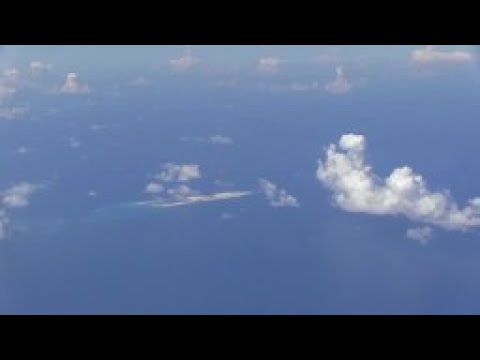
On the first anniversary of its landmark arbitration win, President Rodrigo Duterte, who has opted in his first year in power to engage rather than confront China on the issue, is under rising pressure to take a tougher stance. The pressure comes amid reports China’s build-up is tilting the crucial waterway’s strategic balance in its favor vis-a-vis rival claimants.
The Asia Maritime Transparency Initiative (AMTI), a unit attached to the Washington-based Center for Strategic and International Studies think tank, recently revealed new satellite imagery showing China has installed new missile shelters, radar and communication facilities on three manmade islands at Fiery Cross Reef, Mischief Reef and Subi Reef, all nearby the Philippines.

AMTI claims that all three islands have since at least February hosted shelters with retractable roofs that have the potential to house missile launchers. The research also indicates China has installed large antennae on Mischief Reef that could be “connected to radars for any missile systems that might be housed there.”
With the recent build-up in the so-called “Big 3” features, “Beijing can now deploy military assets, including combat aircraft and mobile missile launchers, to the Spratly Islands at any time”, AMTI’s research said. The tribunal verdict notably ruled against China’s claim to the three reefs based on its recently built manmade islands on the features.
Beijing’s doctrine of “historic rights”, the foundation of the country’s expansive “nine-dashed-line” map that lays claim to nearly all of the South China Sea, is “incompatible” with international law since “there was no evidence that China had historically exercised exclusive control over the waters or their resources”, the tribunal’s verdict said.
It also censured China’s massive reclamation and island-building activities in the Spratly Islands as incompatible with the obligations of UNCLOS member states, especially because they “inflicted irreparable harm to the maritime environment” as well as “destroyed evidence of natural condition of features” in the South China Sea.
The tribunal also criticized Beijing for violating “the Philippines’ sovereign rights’ to exploit its fisheries and hydrocarbon resources within its Exclusive Economic Zone (EEZ) in accordance to international law.”

Crucially, it ruled that there are no naturally formed islands in the Spratlys that can generate their own EEZs, while the Philippines and China have no overlapping EEZs in need of delimitation.
By all counts, it was a clean-sweep legal victory for the Philippines, which was “final and binding” based on Article 296, as well as Article 11, of Annex VII of the UNCLOS.
In response, an enraged China engaged in a systematic campaign to delegitimize the tribunal and its judges, adopting a “three-nos” policy of non-participation, non-recognition, and non-compliance with the final verdict. At the time, Beijing dismissed the award as a “null and void” decision and “nothing more than a piece of paper.”
It also effectively managed to rally international support, including among certain allied Southeast Asian countries, to ignore the arbitration award. Aside from threatening to withdraw from the UNCLOS, which it ratified in 2006, China also proposed to set up its own international arbitration bodies against its supposedly Western-dominated counterparts.
Only Japan, the United States and Australia openly called upon China to comply with the ruling, emphasizing its finality and binding nature under law. Concerned about spiking tensions, however, the Barack Obama administration swiftly deployed then National Security Adviser Susan Rice to China to avoid a retaliatory dust up and calm the Asian giant’s nerves.

The Philippines’ then-newly inaugurated president, however, proved to be a game-changer. Duterte immediately made it clear that he wouldn’t flaunt the award to taunt China, calling for “restraint and sobriety” in pursuit of a “soft-landing” in the disputed waters.
Over the subsequent months, he rapidly upgraded frayed relations with Beijing, and even expressed his preference for strategic “separation” from the US in favor of an alliance with China and Russia.
To China’s delight, Duterte repeatedly refused to raise the arbitration award in multilateral fora, including in the Association of Southeast Asian Nations (Asean), which is currently chaired by the Philippines.
He also downgraded security relations with Washington, nixing large-scale war games as well as plans for joint patrols in the South China Sea in the name of freedom of navigation. He followed up by blocking any criticism of China’s expanding military footprint and island-construction activities in the South China Sea.
Duterte has been richly rewarded for his pivot. China has offered large-scale infrastructure investment deals as well as an unprecedented $500 million loan to the Philippines’ US-leaning military. Almost overnight, bilateral relations went from acrimonious to cordial, with Chinese Foreign Minister Wang Yi recently hailing a “golden period of fast development” between the two sides.

Still, Duterte faces growing domestic pressure to adopt a tougher line with Beijing, which many believe has used cordial ties as cover to consolidate its control over key features. Supreme Court Justice Antonio Carpio, a prominent supporter of the arbitration strategy, lambasted the president’s supposed lack of “discernible direction, coherence, or vision” in foreign policy.
He has heavily criticized some of Duterte’s remarks, particularly his announcement that he “will set aside the arbitral ruling” in the interest of better relations with China. “This incident [Dutetre’s remark] graphically explains Philippine foreign policy on the South China Sea dispute after the arbitral ruling,” exclaimed Carpio during a high-profile event marking the arbitration award’s first anniversary.
He reiterated the importance of the ruling, since it secured “the Philippines a vast maritime zone larger than the total land area of the Philippines.” Instead of setting aside the arbitration award, the magistrate called upon the government to consider filing additional arbitration cases against Beijing if the latter continues its non-compliance with the award.
Senior former government officials, including former Foreign Secretary Albert Del Rosario, who played a key role in the arbitration proceedings, have echoed similar sentiments against the president. Others have openly accused the Duterte administration of soft-pedaling territorial issues in short-sighted exchange for Chinese economic incentives.

Senior defense officials have consistently expressed concern over the prospect of China building structures on the nearby Scarborough Shoal. They have also accused Beijing of plotting to usurp the Benham Rise, which is part of the Philippines’ continental shelf in the Pacific Ocean. China’s continued reclamation activities and militarization of the Spratly islands, meanwhile, have provoked anxieties of Chinese domination of the area.
Despite Dutetre’s best efforts, the tough-talking leader has failed to calm widespread suspicion and skepticism about China’s intentions among the Filipino defense establishment. In response to that internal pressure Duterte declared to Beijing earlier this year that “there will be a time where I have to confront you about this paper, the arbitral [award].”
That time may come sooner than Duterte prefers, especially if China continues to tighten its military grip on one of the world’s most strategically important waterways. The one-year anniversary of the tribunal ruling that once promised to stall China’s advances in the maritime area has showed that Duterte’s engagement has done little, if anything, to slow Beijing’s expansionist designs.

international tribunal’s decision (ruling) on this matter are very clear!!eversince,China has no evidence that shows they have historically excercised exclusive control over that water and resources!hence,their "Historic Rights" has no basis at all??its just a crystal clear indications of their greedy ambitions to control the vast resources of west Phil. sea!!and shows the world that "Might is Right"that no-one can oppose them whatever they liked and wanted to take and control!!inspite of the fact! that they’re a signatory of UNCLOS and a permanent Member of the UN-SECURITY COUNCIL! yet,deliberately violates verdict that came out from that convention!
Yes it takes two to arbitrate, then why China didn’t want to participate?
Japan, US, and Australia can back up their claim and can voice out their disagreement because they have the manpower and weapons!!! Insisting on the arbitrary ruling would only mean asking the US to help the Philippines in claiming the South China Sea, which would mean the US forces would increase in the country and they would again make the Philippines their military base protecting their interest of mining and digging the golds left by the Japanese, which they have done in the past leaving their toxic waste in the Philippines as well by making this country their dumping site of toxic and hazardous waste …In the first place, the disputed place which China occupy is not much of help to the Philippines…Can the Philippines build a structure there??? Look the structure the Philippines can afford to guard its territory in that area is a rotting ship with few soldiers….A pitiful sight!!! Those who insist on the arbitrary ruling are coyed and paid by the US to push the issue…THE FILIPINO PEOPLE ARE NO LONGER NAIVE!!!! WE KNOW NOW WHO ARE THE REAL VILLAINS IN THIS WORLD…
Look where the other 3rd world allies of US are now, if not in ruin is still at war with the millitia the US has funded! Maybe its time to look at US as a WAR maker than a peace maker one! We almost went to WAR with China because of its meddling!!!
President Duterte had very few options. To agree to disagree, seems to be the best solution for the time being. Norway did the same with Russia in the Barents Sea. After 20+ years with agreeing to disagree they meet again and found a permanent solution both parties were happy with.
The Spratley conflict has been used to undermine President Duterte popularity. US State Department, CIA, and the US Navy is extremely concerned about the Philippines improved relations with China and Russia. The US plans to unseat President Duterte is public knowledge. Fortunately, President Duterte huge popularity (78%) is keeping him alive.
The US screams China will use the Islands for military instillations. Sure, China will put military installations to defend the ISLANDS. This poses no additional threat to the US or the Philippines. China has more than enough intercontinental missiles in main land China to defend themselves from US aggression.
For a reason which chinise has vauge claim and keep destroying the marine biodiversity and not listening to the world and if you are really understand the law that is a very good reasoning
It’s a delicate matter because the west came out on top after the second world War. And have been calling the shots ever since. Making the rules, making mistakes, doing good and bad things with the power they have.
Now every country of course want equal rights and some feel mistreated and claim that it isn’t fair.
But that is just how the history went.
The way to deal with it is for countries to show that they pose no threat to the U. S. To be friendly and respectful, not proud, aggressive, insecure. If a country behaves in a responsible way they will easily earn the friendship of America. And would be given all the benefits that this would come with.
Countries acting responsibly like thisfor the sake of their people would be left alone, given sovereignty and assistance.
It’s quite simple really and yet so difficult for people to grasp. The
Wood Wu that’s exactly my point, China is wrong to claim that sea.
It is normal for countries to claim a certain amount of sea area near their coast lines and ports but not to build military bases next to the Philippines and claim the whole sea.
Many other countries have made similar mistakes but it still doesn’t make it right.
Right. Self proclaimed "clear mind".
Respond to my post that was responding to yours under my comment chain.
Stuart Budgen You are not clear on anything.
First of all China realized the claim at end settlement of WWII. However outsized the claim was from 1940s to 1994 NO ONE can dispute that China had the first, legitimate, internationa practiction conforming claim to the SCS. (of the time, only 12NM ocean boundary is considered national territorial waters nations are ought to respect). Phillipines and Vietnam was the law breaking intruder back then, clearing ignoring China’s existing claim and expelled Chinese fishermen from islands to blazanly grabbing it for themselves, these were the original dispute when China was the one wronged. It was only in 1994 that statues quo was changed, not by China but by a new UNCLOS. China was NOT the expansionist nor the statues quo changer here, it is the UNCLOS with its sweeping new rules that is the statues quo changer that dramatically altered other country’s legitimate claims and who’s wrong in the dispute. Its UNCLOS asking China to give up its claims to adapt to it not the other way around. Even so China had maintained its position of negotiations to settle the disputes, which by the way IS ALLOWED under UNCLOS for concerned states to settle their own differences outside the stipulation of UNCLOS, and over the decades of negotiations no one was forced to sign away anything. Heck, China even settled some disputed ocean territory with Vietnam with give-and-take when Vietnam was the global outcast. And remembre how the SCS dispute flareup happened: It was Phillippines that sent its military vessle to arrest Chinese fishermen while negotiations still ongoing, not Chinese sending in its military vessle. Ironically the final UNCLOS verdic came down actually says Chinese fisherman DO have the right to fish there while maintain UNCLOS do not have the mandate to settle the soverignty of the shoal, which means Phillippines was the one completely in the wrong to have persued militaristic hardline means that broguht the dispute to a boil.
Now tell me, which part of it is pure anti philipino? Your simplified responses to me sound like you are just another one of those "media informed" scs dispute "self taught" experts that actually have 0 clue on the real come and goes of the dispute and how complicated it was. I await your response.
Du30 backfired? Nonsense, his approval rating in Ph is as high as ever! People in Ph wants Win-win, not disputes stirred up and abbeted by 3rd party
If China’s sovereignty claim over the South China Sea is reasonable and should be accepted by the world, will China support other countries to do the same kind of claim? For instance, Libya claimed in 1976 that its territorial waters should be 62 nautical mile wide in the Mediterranean Sea. Will China support Libya’s claim? Or Italy might claim the whole Mediterranean Sea as its territory due to its Roman emapire status. Will China support Italy’s claim?
Stuart Budgen –The South China Sea belongs to all the countries in the world including any landlocked country. Like Bhutan and Nepal, they have the same right to fish and mine in the SCS just as any country bordering on that sea. Therefore it is not up to any one country (the USA) to allow or disallow the sovereignty claim by China; the whole world has a stake on the SCS.
I think the name Permenant Court of Arbitration (PCA) should not be used to mean it, PCA, ruled. The correct name to use is the Arbitral Tribunal which ruled, not the PCA. The Philippines or any other disputants can only ask Arbitral Tribunal to rule; they cannot ask the PCA to rule. If we referred to the published language, we will find that the PCA did point out the fact that the rule was done by the Arbitral Tribunal, and the PCA just served as a registrar.
H.E Pres. Duterte probably had very little experience dealing with the 2 faces of Red China right after the Court Ruling. Remember, in all communist regimes, only the Party’s decisions would be respected. Most laws or regulations are only there to be observed. Pres. Xi’s China is an AGGRESSIVE China – away from Deng Xiaoping’s China! Beware!!
Seems that alot of people’s minds here are tainted by feelings of inferiority… Wounded pride etc.
The key here is to be able to see clearly and free of such limitations.
If China’s actions are tainted with such feelings then clearly their expansion is something which needs to be contained and guided.
And I’m not saying this because of the color of my skin… But because my mind is clear enough to see correctly.
Why so anti Filipino?
As the article says Duterte has been very lenient and forgiving to China’s militarization right along the edge of its lands.
Whoever it is who should decide and despite past wars, U.S dominance etc. surely the seas belong to all of the countries in it and should not be militarized by any one country.
If China is to be taken seriously as a rising power we can trust, militarization is not the way.
It should be about co operation and respect, not revenge and domination isn’t it?
No plans should be made with revenge or past glory in mind because this just leads to more fear and instability.
It takes two to arbitrate. How can there be a fair decision in a one sided arbitration ???
the "tribual" ruling is but a laughable piece of paper now.
Just look at US. For whole 7 years in the dispute US STILL fails to ratify UNCLOS while espousing its all for international law.
The other supposedly "law abiding party", Japan, cannot even abide to a whaleing ban LMAO. oh and taken UNCLOS interpretation into its own hands on Okinotori, AFTER the rule setting abritiation came out that clearly would have made Okinotori a rock that does not have EEZ. Claiming ruling is final and bining on china but the clear precedence does not apply to Japan, how cute
http://www.japantimes.co.jp/news/2016/07/15/national/politics-diplomacy/japan-steps-rhetoric-okinotorishima-wake-hague-ruling/#.WWiCtITyuUk.
So even Phillippine’ss 2 supposedly biggest "law abiding ally" exempt themselves to UNCLOS when it suits them, yet these Phillipinoes think they can bind China to the UNCLOS "arbitration". Btw, "arbitration" definition:
the hearing and determining of a dispute or the settling of differences between parties by a person or persons CHOSEN OR AGREED TO by THEM.
Notice that "them"? without "them" its not arbitration, its unilateral declaration that have no moral binding on the other party that did not agree to nor choose. Phillippines made the biggest mistake when it think such "arbitration" will work just because some lawyers says so.
It is going very well, China does not engage in empty bravado and goes about its business diligently in an honest manner. Plans are being drawn after careful studies and consultation. Aid has been given to alleviate the urgent present issue of drug addicts rehabilitation by building facilities. It takes time to build an eco system for development and training of people.
Be patient! It has only been 1 year and not 150 years of past USA involvement .