


“You’re next,” said a Russian historian I interviewed in 1993 about the Soviet Union’s collapse in late 1991. I was an American student in St Petersburg, and he was referring to the United States.
His argument was informed by a pseudo-scientific demographic theory that would eventually find favour in the Kremlin, but more remarkable to me then was the hopefulness with which he spoke.
If this man is still alive, he must be feeling vindicated. America’s current retreat from its engagements around the world — from gutting USAID to abandoning European allies — constitutes a surrender of power comparable in living memory only to Mikhail Gorbachev’s unilateral withdrawals from Afghanistan, Eastern Europe and elsewhere between 1988 and 1991 — right before the Soviet Union’s collapse.
Accompanying both foreign policy about-faces, we can’t miss profound shifts in the two states’ ideological foundations.
Destabilizing master signifiers
Gorbachev justified his “restructuring” or perestroika by invoking the Soviet Union’s founding father, Vladimir Lenin. He did so, however, by observing that the historical Lenin had pragmatically modified policies according to circumstances. That called into question the mythological Lenin — an infallible hero whose virtues could not be questioned.
The Russian-born American anthropologist Alexei Yurchak argues that Lenin was the Soviet system’s “master signifier.”
As long as his sacredness remained unquestioned, referring to Lenin could legitimize a range of policies and actions. Viewing Lenin through a historical lens, however, called his sacredness into question. It consequently became impossible for Soviet citizens to agree on what policies and actions were legitimate. This crisis of meaning allowed chronic political, economic and social problems to suddenly become devastating.
America’s master signifier is its Constitution, reverentially enshrined in Washington, DC, rather like Lenin’s body is in Moscow. Under President Donald Trump, however, violations of the Constitution have become routine, and the federal government’s legislative branch has shown little will to guard its powers from executive encroachment.
Like Lenin under Gorbachev, it seems that the sacred center of America’s political system has become destabilized. As a written contract, a constitution is easier to interpret than the thoughts of a dead man. Lenin’s advantage, however, was that he could embody traits considered virtuous in the Soviet system.
Where could Americans look for that same type of guiding light? For most of American history, it was George Washington — the first president who swore to uphold the Constitution.
George Washington’s America
As a hero of the Revolutionary War, Washington could have become king.
Army officers, frustrated at the central government’s weakness after the war under the Articles of Confederation, considered a coup d’état. Washington — the army’s commander in chief — could have led the overthrow (as Oliver Cromwell had or Napoleon Bonaparte would).
Washington refused, and after British capitulation in 1783, he relinquished his command to Congress.
In 1789, after the Constitution was ratified as a legal solution to the problems of confederation, Washington was unanimously elected president. After two terms, however, he rejected suggestions that he stand for a third.
He frequently stressed the importance of habit in human affairs and reasoned that, if he clung to power, Americans might not get accustomed to peaceful and regular rotation of office. By retiring, he transferred much of the reverence that had accrued to him onto the Constitution.

Remembering Washington
Washington’s birthday falls on February 22, and Americans began observing it while he was still alive. In 1879, US Congress made the day a federal holiday, an occasion for celebrating the example of selfless public service and respect for the rule of law that “the father of his country” had embodied.
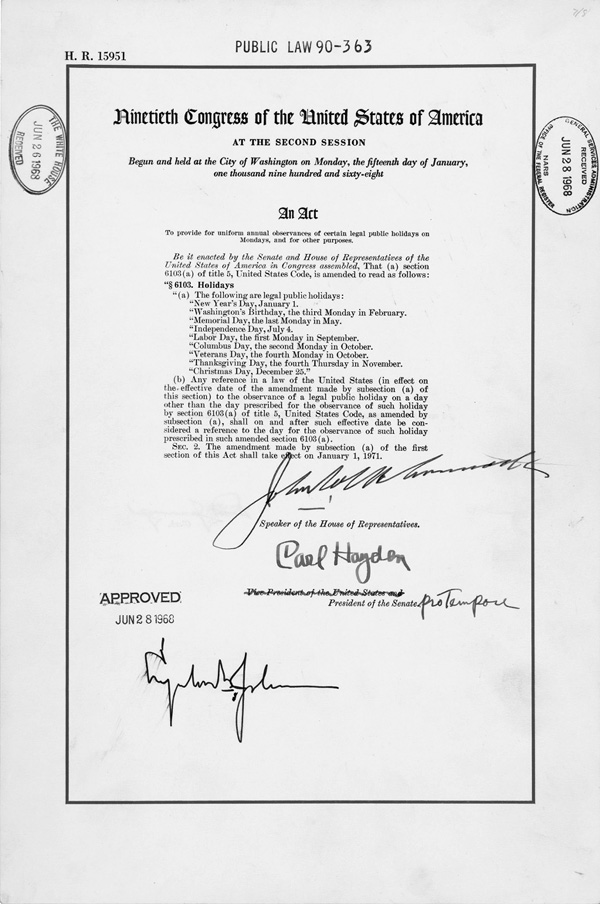
So it remained until 1971. In that year, the Monday Holiday Act went into effect. Adopted in 1968 at the behest of the business lobby, which saw in three-day weekends an opportunity for sales, the act moved Washington’s birthday commemoration to the third Monday in February.
Since many states also celebrated Abraham Lincoln’s birthday and the new date fell between his and Washington’s, some began calling it “Presidents’ Day.” When nationwide advertisers and calendar-makers adopted the term in the 1980s, it came to seem official.
The name change, of course, eroded the holiday’s connection to Washington, and insofar as it remained more than a shopping day, it came to be associated with all the presidents, effectively cheapening it.
Though the federal holiday officially remains “Washington’s Birthday,” few Americans know that.
The dangers of mythologizing
The shift happened to coincide with a wave of revisionist historiography that pointed out Washington — a slave-owner — was not perfect.
All historiography is revisionist in the sense that historians revise existing interpretations on the basis of new evidence. For those who wanted an untainted idol, however, it appeared either that Washington could no longer fit the bill or that historical facts had to be massaged.
Ever since, historical assessments have tended to get lost in culture wars, where neither side can accept a real person with both reprehensible and admirable traits.
In the Soviet Union, however, most citizens found it difficult to think historically about Lenin because, under the conditions of dictatorship, open public debate based on factual information about him had been impossible.
Dictatorship depends on mythological thinking that worships heroes and does not expose contradictions between official pronouncements and reality. In the early 1990s, Russians failed to establish the rule of law for a similar reason: they could not overcome the habit of mythologizing, which made them prioritize personality over policy.
The personality they chose as independent Russia’s first president — Boris Yeltsin — lacked Washington’s respect for the rule of law.
Losing sight of Washington
Thanks to Washington, the US got off to a better start. But by abandoning the widespread commemoration of his historically exceptional deference to the rule of law, Americans have lost an opportunity to practice historical thinking in the public sphere.
Not only has mythological thinking encroached, but it is now even possible for a president to style himself as a monarch and to emulate Napoleon, as Donald Trump has.
The Constitution — America’s master signifier — has lost its ability to unite citizens around a shared sense of meaningfulness. Will Washington’s country be next?
James Krapfl is associate professor of history, McGill University
This article is republished from The Conversation under a Creative Commons license. Read the original article.

There is not the slightest possibility of the United States going the way of the Soviet Union.
Why not?
To answer the question myself: The SU was a multinational state and fragmented along the ethnical divisions. The US are mostly homogeneous.
However, there are still huge cultural and political fissures within the US, and in the long run, I can easily imagine the Southern states going back to Mexico, New England and the West coast states becoming separate countries each, and the fly-over-states falling prey to whoever would want them.
The S states would not want to join Mexico, after all half of their populations left Mexico in the first place.
The US isn’t “homogeneous”. It is racially diverse. The different groups often hate each other, but so long as good times exist, they agree to live together and save the argument for another day. The moment the good times end, all bets are off. The Southern states won’t go to Mexico (maybe you meant Southwestern states, because those are the ones with large Mexican populations which Mexico has a tangible claim to?). But the South seceding has already been tried before, and it won’t take much for them to try again. Meanwhile, the liberal Northeastern and Western states don’t want anything to do with the South or the conservative heartland. They won’t have a problem with the South going its own way. The liberals themselves may be the ones to initiate the secession this time. Unlike Lincoln, the South won’t even have a problem with the liberal states leaving. As the fissures deepen, as the US declines, and things go from bad to worse for more and more people economically (the gap between rich and poor is always widening), all bets on an implosion of the US are off.
The US has the largest military spending, has the largest debts, has half zombie half old people to lead the country, and yes, the US is withdrawing every where. It is eerily similar.
Yes, I also think that it is eerily similar. Hmmm…
How old is Winnie Xi Pooh, and the rest of the Politbureau ?