


International condemnation of the conviction of two Reuters journalists, Wa Lone and Kyaw Soe Oo, a seven-year sentencing under the 1923 Official Secrets Act for reporting serious abuses in Rakhine State, has rightly directed anger against the civilian government of de facto national leader Aung San Suu Kyi.
Her ruling National League for Democracy (NLD) has over 100 former political prisoners in the national parliament, and for years promoted freedom of expression and democracy. They have trammeled all over those convictions since they were elected to power in late 2015, with the two Reuters scribes as the latest victims of the NLD’s near total rejection of democratic values.
Suu Kyi’s dismissal of concern for the two investigative reporters being ensnared in a hackneyed security forces sting operation, over an alleged massacre in Maungdaw Township of ten Rohingya men, a cold blooded murder the military eventually admitted their personnel perpetrated, was in evidence almost from the time they were arrested last December.
Indeed, the state counsellor reacted with fury at anyone who had the temerity to raise the case, from former US Ambassador to the United Nations Bill Richardson, to the Japanese Broadcaster NHK, who she admonished for mischaracterizing the case as related to their reporting on the Rakhine crisis, while insisting they were charged because they “broke the Official Secrets Act.”
She clarified by stating, disingenuously, “we follow the due process and everybody is free to follow the court proceedings to find out whether or not they are fair, whether or not they are in accordance with the rule of law.” Anyone who attended the proceedings would have concluded that due process was as absent as common sense in the case’s prosecution.

The jailing of two young journalists pales in comparison to the crimes they were bravely investigating: the military’s wholesale torching of northern Rakhine state, the rape and murder of thousands and the expulsion of over 700,000 Rohingya Muslims.
But in the helplessness many in Myanmar feel towards the military and civilian government’s confounding rejection of all reports of mass crimes, Kyaw Soe Oo and Wa Lone represent common decency, the spirit of defiance the NLD once claimed moral leadership over as they struggled to overturn a rotten military-led authoritarian system where courts were weaponized against dissent and rule of law really meant rule by law.
There was a weary hope that some measure of contrition could emerge after months of the politically-captured judiciary punishing the reporters for supposed breaches of national security, within a wider milieu of refulgent reactionary nationalism over perceived as undue international pressure over the Rakhine crisis.
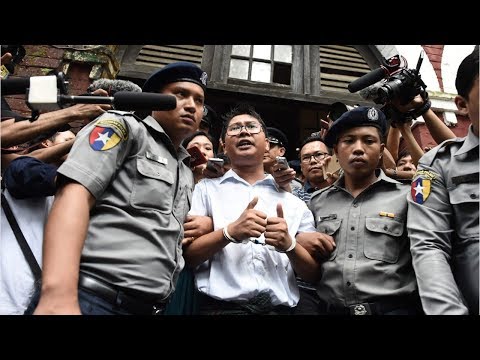
Every court hearing, attended by the press corps and many diplomats, was a testimonial to the government’s stubborn refusal to drop the charges.
Myanmar has now descended into a deep sleep of reason, from Suu Kyi, to the leadership of the military, to vituperative xenophobes on Facebook denouncing everyone from “Bengali terrorists” to “neo-colonialists” for United Nations and other international criticism that the crimes committed against the Rohingya may constitute genocide.
The NLD government had a momentous opportunity to mitigate a measure of this international pressure by releasing the two reporters after several months of high-profile global calls on their behalf, ranging from the Pope to horror novelist Stephen King. It was as if the verdict on Monday would also cast judgement on the Myanmar government’s quality of mercy. It did and that quality is in horribly low supply.
There was a firestorm of anger on Facebook and other social media from Myanmar journalists and activists in the hours following the judge’s decision. The animus from progressive Myanmar media and activists towards Suu Kyi and the NLD government is at an all-time high, as the Reuters case served as a lightning rod for the elected government’s dubious commitment to democratic norms.

The international denunciations were as swift as they were sadly predictable given the months of appeals for leniency from around the world. The United Kingdom’s ambassador to Myanmar Dan Chugg said the verdict dealt “a hammer blow to the rule of law.” The US Embassy urged the government to immediately release the reporters and “to end the arbitrary prosecution of journalists doing their jobs.”
The court’s decision came amid broader pressure on the media in Myanmar, including the legal harassment of Ko Swe Win, a prominent reporter and editor of Myanmar Now. He has been charged under Section 66(d) for allegedly defaming the firebrand Buddhist monk U Wirathu, a charge the journalist denies and refuses to apologize for.
Over a year of harassment has seen Swe Win arrested at airports and transferred to a court in Mandalay to endure absurdly protracted proceedings. If Suu Kyi perceives this dysfunctional justice system as something to defend in the Reuters case, then she is actively complicit in using the law to punish reporters who deliver inconvenient truths.
Several young Myanmar reporters are leaving journalism altogether because they are no longer prepared to take the risks of government harassment, arrest by security forces, or the incessant online and sometimes threatening trolling of their reporting. They are seeking study opportunities abroad or leaving to work in the less risky field of non-governmental organizations (NGO’s) or the private sector.
Mratt Kyaw Thu, a distinguished reporter from Frontier Myanmar, a bi-weekly news journal renowned for its courageous coverage of Rakhine and other conflict areas, underlined the dire state of affairs for the media at an East-West Center media conference in Singapore in June.
“I don’t want to introduce myself as a reporter in Myanmar, because we feel ashamed to be journalists in Myanmar,” he said. “Nobody respects us, whether they are military, government or parliamentary member, everyone, they don’t give any respect. In fact, the Myanmar journalism industry has collapsed, it’s sad to say, but it’s a reality.”

Photo: AFP/Ye Aung Thu
There were high hopes that the NLD government would repeal or amend many of the laws used by their military predecessors against the media and civil society, including provisions of the Telecommunications Law and colonial era laws such as the Official Secrets Act.
Instead, the NLD have kept nearly all of them on the books and permitted their liberal use against media workers who are critical of the government, military, private sector and even ultra-nationalist Buddhist monks.
Government departments have also mined obscure provisions of the Penal Code to extract intimidating tools to curtail the media, including Section 124(a) for the crime of sedition, and threaten journalists with imprisonment for any deemed as undue criticism of the government.
Eaint Thiri Thu, who worked previously as a fixer for the New York Times, Wall Street Journal and several other prominent international news organizations for several years, and who has ventured into multiple conflict zones in her country, said, “It is like we are walking through landmines of unjust laws, that any journalist or citizen can step on at any time.”
This intimidation hasn’t completely deterred a younger generation of free speech activists. On Saturday, dozens of journalists, poets and their supporters demonstrated through mid-town Yangon to demand the release of the Reuters journalists and respect for freedom of expression.
They included journalist Aung Naing Soe, who was jailed for two months in 2017 for allegedly planning to fly a drone over parliament with two foreign reporters, the poet Maung Saungkha, charged and imprisoned for six months under 66(d) of the Telecommunications Law in late 2015, youth activists of Generation Wave, and leaders of the Protection Committee for Myanmar Journalists (PCMJ).
The authorities permitted their procession, although a similar peaceful demonstration in solidarity with civilians suffering in the war in Kachin state in May this year was violently suppressed by police, who have charged an estimated 47 activists with unlawful assembly.

The onslaught against the press is being enabled by messaging from senior government and military officials who regularly call on the media to serve the national interest rather than check and balance their actions and pronouncements.
Suu Kyi has stubbornly refused to champion media freedoms, promoting instead her latest catchphrase “collective strength” to chide any perceived deviation from loyalty and unity with the state. It is a departure from her hackneyed refrain of “rule of law” over the past several years, a slogan now demoted to terminal insincerity in the wake of the politicized Reuters verdict.
The military is also to blame. In June, Tatmadaw Commander in Chief Senior General Min Aung Hlaing said in a meeting with the Myanmar Press Council that the press was an important institution as “(t)he media’s description greatly affects the stability, development and unity of the country. The media should bring about unity and should also make criticisms where necessary. Only then, can it support the country’s development,” he reportedly said.
The press council vice-chairman, Ohn Kyaing, was reported to have concurred by saying “the Tatmadaw and the media are of the same mind and aim.” Such statements have further demoralized younger reporters who feel abandoned not only by their elder journalists, but also the NLD and 1988 generation of activists who they previously held as pro-democracy icons.
In his inaugural speech in March, President U Win Myint mentioned the promotion of human rights three times (unlike his nominal superior Suu Kyi, for whom it is now seemingly a sullied term). He also said: “I wish to urge the media sector, which serve as the ears and eyes of the public, to understand the seriousness of their duties and to hold in high regard the public sector that they serve.”
Some journalists perceived this as a supportive message for their checking and balancing role. However, the president, like his predecessor, appears to have little real power. It is within his purview to pardon and release Kyaw Soe Oo and Wa Lone, for which domestic and international interlocutors have already strongly called. Those calls will no doubt fall on the deaf ears of Suu Kyi’s office, through which any executive pardon will no doubt need to be approved.
Since the previous military-backed regime lightened up on media censorship in 2012, Western donors have poured money into trainings for state media, an investment of diminishing returns now that much of that sector has become a delivery vehicle for government propaganda.

Those funds would now be better invested in independent media and young aspiring journalists, with an emphasis on conflict reporting and a deeper commitment to ethics to rebuild the quality of domestic coverage following the deep scars exacted by the Rakhine conflict.
International support is also a psychological salve for many journalists who continue to strive bravely to uncover hard facts in the face of government and Tatmadaw harassment.
With the Reuters reporters now serving seven years behind bars, will reporters dare to report critically on the shipwrecked nationwide peace process and intensifying ethnic armed conflicts across the country? Is it even remotely conceivable in sight of the Reuters precedent that local publications will challenge the government’s and military’s wholly unconvincing cover-up of their mass crimes in Rakhine state?
Suu Kyi’s government and Min Aung Hlaing’s military have unleashed ultra-nationalism in the service of covering up systematic abuses and in the process radicalized public opinion against the press. Will the NLD and Tatmadaw harness and intensify these furies to encourage even more self-censorship among the media?
The Reuters case is not just about two principled investigative reporters caught in the grinder of defiant official denials of the crimes against humanity perpetrated in Rakhine state. It remains an official rallying cry to punish any news coverage that refuses to conform with their pro-state messaging. And that is why the Reuters verdict has likely crushed whatever dogged morale remained among the media community.
While in the opposition to abusive military rule, Suu Kyi often appealed to the world to “use your freedom to promote ours” while she was under house arrest. The real justice from this disgraceful chapter of Myanmar’s transition will be using that same phrase against the patrician indifference of a once iconic leader who has renounced the very values she rose to democratic power on.
David Scott Mathieson is a Yangon-based independent analyst

Joe Wong, Your question, Why Myanmar does not deserve fair hearing. Please look into the statements of UN, HRW and ICC and also on news papers around the world.
Nurun Nabi Whatever, whoever came into the trap was caught.
Nurun Nabi, you are trolling fake news, the 2 photographers were proven processing state secretes without authorization in the court. Besides they are employees of foreign correspondence who often are 5th colonists to spearhead colour revolutions in a nation for the NED, CIA and MI6.
When are you sending George Bush, Dick Cheney and Tony Blair to ICC for their war crimes, crimes against humanity and crimes against peace in the ME? If you send them to ICC to be convicted then ICC could be credible.
Nurun Nabi, the crimes were created by the Indian and FUKUS to punished Myanmar because Aung San Suu Kyi and Burmese refused to be the cannon fodder for the Indian and FUKUS in their new cold war to destroy the rise of the SE Asia. Crimes are the amplifier in your propaganda against the victims, it always has been since Columbus time, regardless where the FUKUS have been, history has proven that.
Nurun Nabi, UN Rohingya investigation unit, HRW and ICC are not credible because they are established by the Western imperialists to gloss over their war crimes, crimes against humanity and crimes against peace, as well as to frame victims with fake news and evidence. There are plenty of evidence on the internet proving them not credible, get up from your couch and look for yourself, couch potato.
You, the Indian and FUKUS, can leave the UN if you don’t like the other UN members not allowing you to use UN as a tool to bomb, kill and torture others on the fabricated evidence. Leave now, nobody is stopping you, the rest of world will move UN HQ out of New York tomorrow.
Did you read Asians telling you and your masters to get lost and stop destroying the peace and prosperity with fake news and false flag ops organized by NED, CIA and MIA and carried out by their proxies?
Joe Wong , But Indian P.M Mr. Modi kept his mouth shut when he was in Myanmar state visit.
Joe Wong , Joe I have a simple question to ask you.
I beg your pardon to ask this. Do you have a wife or daughter, mother or sister. Say (forgive me) if they fall in the hand of criminals and get raped in your country . Will you blame India or the West.
Crime and propaganda are not same that all civilised people knows, except Min Aung Hlaing and you.
Joe Wong , As per your statement, Who gave explanation why UN’s. HRW and ICC are not credible. Show me those EXPLANATION. So far you did not allowed UN, HRW and ICC to visit the killing fields of Rakhyne. What are you hiding Sir.?
Can you tell me why you don’t leave UN?
Did you read . Myanmar "Where"Genocide" does’nt really matter on August 30th Asia Times.
Nurun Nabi, This article was exposed by readers as part of the propaganda engineered by the West to demonize Myanmar and Aung San Suu Kyi in their new cold war to destabilize SE Asia. Proxies like you trying to legitimize this kind of fake news must be exposed and rebutted.
Nurun Nabi, You are always alleging but never answer any question why Myanmar does not deserve a fair hearing, but keep on repeating that the West’s demonization of Myanmar must taken as given truth, despite you are given detailed and factual explanations that the Rohingya issue needs to be looked at objectively.
You are given explanation why UN’s Rohingya investigation unit, HRW and ICC are not credible, you are also given India’s unscrupulous motive in the Rohingya issue, you have no defence but repeating falsified allegations, what is Indian’s agenda?
Why India does not allow Rohingya returning to their ancestor’s homeland? Why does Indian defend the perpetrators of the Rohingya tragedy relentlessly?
Joe Wong , Joe, This news article is about your Army and Min Aung Hlaing. If you have to tell anything to India ot USA, send your letter to them. You are deliberately jumping to hide the crimes by your army.
Joe Wong , This news article is about these 2 photographer who tried to bring truth on genoside by your army. WHY you are bringing India and UNSC. Joe, you are deliberately avoiding to tell the crimes by your army. Joe, tell, when you are sending
Min Aung Hlaing to ICC ?
Is this not a sublime example of ATimes "calling the kettle black"?
Nurun Nabi, ICC is a disappointment, they have been acting as a facade to gloss over the West’s war crimes, crime against humanity, and crime against peace. ICC needs to prosecute the real war criminals like George Bush, Dick Cheney, and Tony Blair. India needs to stop licking their master’s boots in order to earn their pat on the head.