


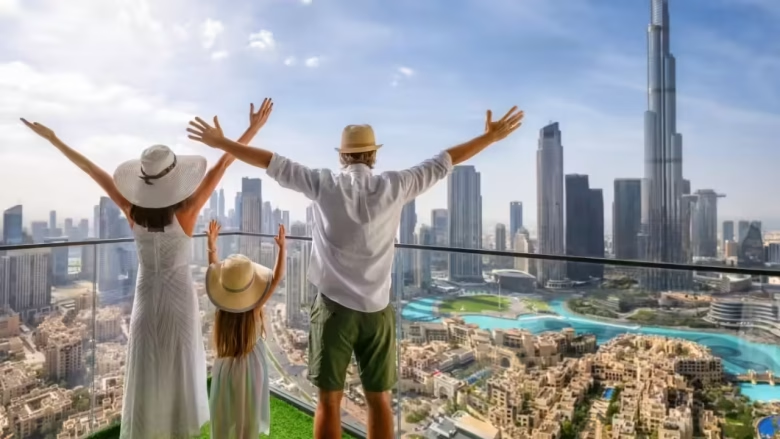
To this visitor, the desert cities of the Gulf such as Dubai, Abu Dhabi and Doha have long felt like the closest equivalent on Earth to colonies on the Moon. With labor imported, raw materials imported and many of the residents imported, the main difference is that one can arrive by airplane rather than space rocket. Now that this already artificial environment has been put in severe danger by the US-Israel war with Iran, these moon colonies are going to face a fight for survival.
It is, of course, not entirely fair to describe the United Arab Emirates, Qatar, Bahrain and Kuwait as being like moon colonies. All do have their own histories and national identities. So do their geographically bigger neighbors of Saudi Arabia and Oman, but the point is that the artificial and the natural are in closer balance in those countries than in the United Arab Emirates and the smaller Gulf states. Only a little over a tenth of the 11 million population of the UAE are Emiratis: the rest are expatriates and migrant workers.
The challenge now faced by the Gulf states is that so much of their population is potentially mobile: Migrant workers can just be sent home to India, Bangladesh or the Philippines if they no longer have jobs, but expatriates too can move swiftly to safer places, taking their wealth with them. The danger is that these moon colonies could suddenly become deserted, now that their water desalination plants have come under Iranian attack and their hotels and apartment blocks no longer look as safe as they once did.
Unless the war lasts for months or the fighting escalates dangerously, Dubai, Abu Dhabi, Qatar and Bahrain are not in fact going to find themselves deserted. They retain some important advantages, not least that they are convenient offshore hideaways for rich people from the east, especially China and India, as well as from the west, with very favorable tax rates. Europe’s top criminals used to hide on the Spanish coast; now they tend to hide in Dubai.
Nonetheless, rebuilding the Gulf states’ reputations after the war is going to take a lot of time and money. The Gulf industries that are going to suffer the most immediate damage will be tourism and aviation. This is because the customers of those industries have plenty of choices, and it will take quite a while before tourists again choose in large numbers to take their holidays in a war zone and before changing planes en route between Asia and Europe again looks like an appealing option.
Other destinations that have suffered terrorism or wars have eventually found their way back on to the tourist trail, but often in numbers that remain below their peaks for a long time. Egypt is the obvious example: the Nile and the Valley of the Kings are again attracting mass tourism, but it took roughly a decade after the Arab uprisings and the Egyptian revolution of 2011-14 before numbers recovered to their previous peaks. The coronavirus pandemic delayed the recovery, but the fundamental problem lay in the security situation.
Some other Gulf industries will be far less affected by the Iran war, most obviously financial services. But if the expatriates whose wealth is being managed there decide to leave, then those industries too will be hurt. So will industries that are dependent on secure and low-cost infrastructure, particularly the data centers that have been under construction in the Gulf to attract artificial intelligence companies.
Unless world oil prices stay high for a long time, those industries will in future again benefit from cheap and reliable energy, including abundant solar power. But the cost of protecting such infrastructure from potential future missile and drone attacks is now going to soar, as will the cost of insurance.
Unlike on the moon, the Gulf states will have a chance to recover. Some of their basic attractions to expatriate residents will be able to be recreated, especially thanks to their geographic location between east and west and their status as hideaways. But recovery is going to be costly. And some of the region’s attraction as a safe crossroads with sun, swimming pools and vast airports will not be recovered for a long time to come.
First published on his Substack, Bill Emmott’s Global View, this is the English original of an article published in Italian by La Stampa.

Maybe the gulf dictatorships will move from”on person with a vote” to “one person one vote”