


Israeli prime minister Benjamin Netanyahu’s trip to Washington on February 11 appears not to have achieved what many observers saw as its central purpose: to persuade Donald Trump to harden his demands on Iran to the point that negotiations between the countries fail.
According to reports, Trump told Netanyahu he wanted talks with Iran to continue. What will be concerning Netanyahu is that while he can probably rely on Trump to take a hard line on limiting Iran’s nuclear program, it is less clear where his unpredictable ally stands on limiting Iran’s ballistic missile capabilities and ending its support for regional armed groups.
Trump had previously indicated that any deal with Iran had to include missiles. But more recently, he has suggested the US may be open to dropping this demand. On February 10, when asked by a reporter if an agreement with Iran would be acceptable if it only covers nuclear issues, Trump said: “Yeah, that would be acceptable, but the one thing and right up front, no nuclear weapons.”
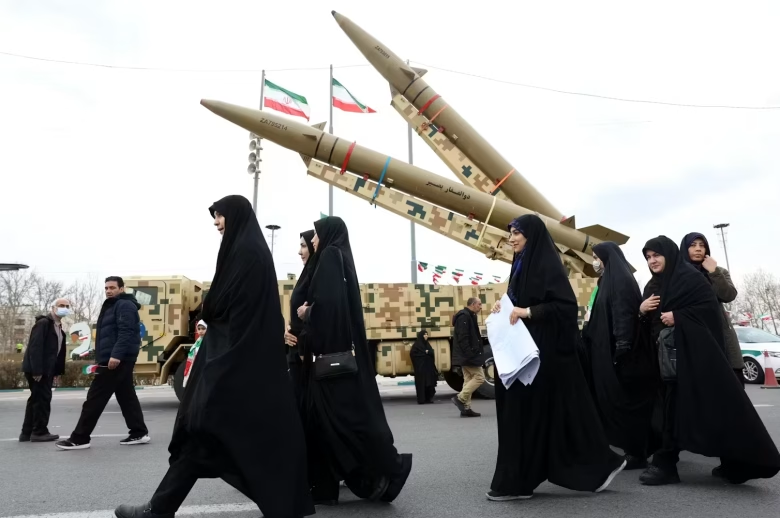
This, as well as positive statements by US and Iranian officials about their brief indirect talks in Oman days earlier, will have spooked Israeli officials. Both Iran and Israel understand that it is missiles, not nuclear enrichment or even Iranian regional proxies, that underpin Iran’s increasingly shaky deterrence.
[A]sked by a reporter if an agreement with Iran would be acceptable if it only covers nuclear issues, Trump said: “Yeah, that would be acceptable, but the one thing and right up front, no nuclear weapons.” This … will have spooked Israeli officials. Both Iran and Israel understand that it is missiles … that underpin Iran’s increasingly shaky deterrence.
For the moment, Trump seems to think that a deal limited to the nuclear issue may be preferable to going to war to tackle everything else. Yet opponents of US military action, which include all of Washington’s Middle Eastern allies except Israel, should still be worried.
It is far from clear whether Iran will offer the kind of nuclear deal Trump would find acceptable, and Trump himself does not seem to know what else to do other than double down on military threats. That alone may scupper the talks.
Netanyahu is also a seasoned political operator who showed how adept he is at maneuvering Trump into supporting military action in 2025, when the US joined Israel in striking Iranian nuclear facilities. And the current US military build-up in the Persian Gulf has now reached a point where that option is on the table.
Trump’s Iran policy
The uncertainty over whether Trump will strike Iran underscores how shallow his Iran policy is. He does not have a conventional, institutionalised policy apparatus of the kind the Obama administration relied upon to negotiate a deal to limit Iran’s nuclear program in 2015.
Instead, Trump is pursuing indirect talks with Iran that are being overseen by two officials with no prior diplomatic experience. These two officials, Steve Witkoff and Jared Kushner, have simultaneously been tasked by Trump with ending the war between Russia and Ukraine.
Trump also seems undecided about whether any deal should focus narrowly on the nuclear issue or whether he should pursue something resembling a grand bargain. Nor has he articulated what he is prepared to offer Iran as part of a deal or how he would justify incentives such as sanctions relief for a regime that has just murdered thousands of its citizens in a brutal protest crackdown.
His approach to Iran is so ad hoc that it allows different groups with access to him, Netanyahu on one side and increasingly assertive regional states such as Saudi Arabia, Qatar and Turkey on the other, to influence key decisions. It was this latter group of Middle Eastern states that intervened recently to press Trump to proceed with talks when they threatened to collapse over Iran’s refusal to discuss issues beyond the nuclear file.
These states are cautioning Trump that US strikes might precipitate the collapse of the Iranian regime. However desirable that might seem, experience in Iraq, Libya and Syria suggests that state fragmentation, mass displacement, violence and regional destabilization would be more likely than any orderly democratic transition.
And if strikes fall short of toppling the regime, even a weakened Iran could inflict serious economic and strategic damage on Gulf oil shipping and infrastructure.
Trump’s ad-hoc approach to diplomacy is in stark contrast to the Obama administration’s negotiations in 2015. Then, the International Atomic Energy Agency provided compliance verification and technical expertise, and the EU chaired the joint commission that oversaw the deal’s implementation. The UN security council formalized the agreement under international law and established a mechanism for reimposing sanctions in the event of noncompliance.
There was also a clear, if largely unfulfilled, strategic rationale related to Obama’s desire to reduce the US’s regional footprint and pivot towards Asia.
Trump’s approach is radically different. He withdrew the US from the nuclear deal in 2018 without a clear plan for what would replace it beyond something he could describe as better and attach his name to. He has no interest in brokering a multilateral agreement and does not appear to have a coherent set of demands or strategic aims that could anchor one.
A thin deal without substance, institutional anchoring and clear mechanisms for handling the inevitable disputes over sanctions relief and compliance is unlikely to endure, even if Trump can push the Iranians into signing it.
Christian Emery is an associate professor in international politics, UCL School of Slavonic and East European Studies, University College London.
This article is republished from The Conversation under a Creative Commons license. Read the original article.
Iran will soon be finished asking with its cruel religion of suppression.
Iran’s rocket force is about the only offensive power it has. Defensive power is almost non-existent, last year and the year before they were unable to defend their airspace. This year it will be no different. Air defence demands rational thinking, nary a forte of men ruled by religion.