


The August summit between US President Donald Trump and South Korean President Lee Jae Myung produced little substance. Yet one remark stood out and echoed far beyond the meeting room. Trump mused aloud that the United States should own the land where nearly 28,500 American troops are stationed.
“We spent a lot of money building a fort, and there was a contribution made by South Korea, but I would like to see if we could get rid of the lease and get ownership of the land where we have a massive military base,” he said.
To many Koreans, long wary of US withdrawal, this sounded almost reassuring. It suggested permanence, not abandonment.
For a nation under the shadow of North Korea, with a colonial past under Japan and an uncertain future with China’s rise, permanence seemed better than the nightmare of sudden withdrawal.
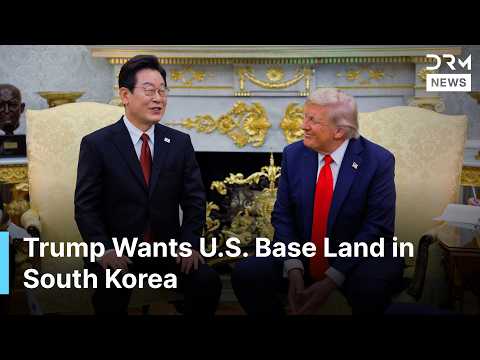
But reassurance quickly fades. The ownership remark was more than careless rhetoric. It betrayed a fundamental misunderstanding of the US-South Korea alliance and risked undermining the very foundations of America’s role in Asia.
How bases actually work
Under the US-Republic of Korea Status of Forces Agreement (SOFA), Washington does not “lease” bases from Seoul. Nor does it pay rent. Seoul grants the US use rights for military purposes while sovereignty over the land remains fully with South Korea.
This model is not unique. Since World War II, from Germany to Japan, America has operated abroad not by owning territory but by being hosted by allies.
As the Congressional Research Service noted in 2024, “With certain limited exceptions, the United States does not typically maintain overseas bases without the agreement of the host nation.” That distinction matters – and it is the line Trump blurred.
The Philippines case offers a lesson in how that sort of relationship historically has worked: When US bases there came to be seen as symbols of occupation, domestic pressure forced their closure in 1991. America’s access was restored only after years of repairing the alliance and only on terms that respected Philippine sovereignty.
For Koreans, who endured Japanese colonial rule within living memory, the symbolism of US ownership would be likely to backfire. It would flip the alliance’s logic, turning the US from guarantor into occupier.
Most importantly, ownership would make the United States a landlord rather than a guest, recasting its role from maritime power to continental power – with grave implications.
Maritime versus continental power
Naval historian Sarah Paine draws a sharp line between maritime and continental powers.
Maritime power, she argues, is positive-sum because it creates wealth through trade, institutions and alliances. Continental power, by contrast, is negative-sum, relying on territorial conquest and destroying wealth in the process.
America’s genius has always been maritime. From the Pacific War to the Cold War, US power rested not on land grabs but on naval projection and a network of alliances. Consent, not coercion, built that foundation.
Ownership would flip that logic, inviting comparisons to the very continental powers America has opposed – China, Russia, even imperial Japan.
South Korea as a maritime partner

Seen in this light, South Korea is not just another host nation but a pivotal partner in America’s maritime posture.
Though not an island, it anchors the first island chain and serves as a maritime outpost of immense value.
General Xavier Brunson, commander of US Forces Korea, told an audience at the Land Forces Pacific symposium in 2025 to imagine rotating a map of the Korean Peninsula so the east is at the top.
“From a satellite image, the ROK looks like an island – or like a fixed aircraft carrier floating in the waters between Japan and mainland China,” he said.

He added that the triangle linking South Korea, Japan, and the Philippines ties together US allies likely to be drawn into any Taiwan crisis. Forward presence in Korea, he stressed, is not just a tripwire but “a signaling instrument” of America’s commitment and will to fight alongside its ally.
The power of this vision lies precisely in being a presence by invitation – proof that America stands with Korea as a partner, not a proprietor.
Strategic consequences
The free world rests on respect for sovereignty. That path is harder than the shortcuts of dictators, but it is this mutual respect that made the United States great – and accepted as leader of the free world.
That is why careless talk of “ownership” is so corrosive. It blurs the very principle that set America apart.
And while Washington muddies its message, Beijing pushes ahead with its Belt and Road Initiative, binding neighbors to its orbit by land and sea. This is continental ambition fused with maritime expansion.
America’s answer must be the opposite. Its strength has always been presence without ownership – alliances, not colonies; consent, not coercion.
Anchoring the first island chain, South Korea is central to that posture. Reassurance comes not from talk of ownership but from America standing with Seoul as a partner. That is how the US-ROK alliance endures – and how the free world keeps adversaries in check.
Hanjin Lew is a political commentator specializing in East Asian affairs. Jio Lew contributed research for this article.
Look at how U.S. treats Koreans as dogs in Georgia.
These two chinese U.S reared dogs will also suffer fate soon.
Not a good time to be right winger/american poodle in Korea today, it is getting hard to wave that star and stripes flags.