


Both the Russian and the US side say that the high level diplomatic meeting held in Riyadh, Saudi Arabia on the morning of February 17th was successful.
Steve Witkoff, who is Trump’s number one troubleshooter, said that the meeting was “positive, upbeat, constructive and very solid.” Sergey Lavrov, Russia’s Foreign Minister and counterpart to US Secretary of State Marco Rubio, said the meeting in Riyadh was “very useful.”
Officially the US delegation was led by Rubio along with Mike Waltz, national security advisor to the President, and Witkoff. We do not have information on others present on the US side.
Rubio said that the meeting agreed on three main items:
- setting up diplomatic teams aimed at improving diplomatic operations in Moscow and Washington;
- establishing high level teams to sort out the “parameters of the conflict” in Ukraine; and
- a third track to identify opportunities for economic cooperation that could develop after the Ukraine conflict is settled, which the US side characterized as a “potentially historic economic opportunity” for Russia.
Lavrov also explained that a meeting of deputy foreign ministers would take place to work out the details of a Trump-Putin meeting. No specific date was set for a Trump-Putin meeting.
The Russian delegation at the top level included Sergey Lavrov and the presidential foreign affairs advisor to Putin, Yury Ushakov. Also in the Russian delegation was Kirill Dmitriev. Dmitriev serves as the CEO of the Russian Direct Investment Fund (RDIF), Russia’s sovereign wealth fund. Also present on the Russian side were Vladimir Proskuryakov and Dmitry Balakin.
Proskuryakov works in the Russian Embassy in Canada and specializes in Arctic affairs. Possible cooperation in the Artic was a topic of conversation in Riyadh. While no details are available, it is likely the discussion touched on the exploitation of Artic resources and the development of shipping routes if the Artic-melt continues as a result of climate change.
It is reported that Dmitriev held side meetings in Riyadh on monetary and investment issues, but we don’t know who served as Dmitriev’s counterpart, although that could have been Steve Witkoff.
In regard to diplomatic operations, both the US Embassy in Moscow and the Russian embassy in Washington are operating under restrictions that need to be lifted, essentially moving toward normalization in the diplomatic sphere. This includes many elements. Calling attention to this, Mr. Lavrov said after the meeting that “It is necessary to remove the obstacles created by the Biden administration that hinder the work of diplomats, including constant expulsions and seizures of real estate.”
No specific conclusions were reached on Ukraine, but Lavrov made a telling point in debriefing the meeting. Lavrov said “Not only did we listen, but we genuinely heard each other.”
Kyiv was not represented at the talks, nor was any European state or organization invited. The lack of participation has touched off a firestorm in Europe, leading to an “emergency” meeting called by France (but excluding some NATO members who are against supporting the Ukraine war).
Director General of NATO Marc Rutte, did attend the Paris meeting. It isn’t exactly clear why he did so, with some NATO members not invited, nor is it clear why he would do so without US agreement.
One result of the meeting, attended by the EU as a participant, were harsh statements aimed primarily at Washington and British pledge to send troops to Ukraine as part of some “peacekeeping” venture. The Germans, Italians and Poles disagreed with the British initiative.
The Russians have made it clear at the Riyadh meeting and in public statements, that NATO “peacekeepers” would not be welcome.
Lavrov said in his debriefing that a so-called three-step plan for Ukraine is a fake. The alleged plan has been attributed to Marco Rubio. “The plan includes high-level meetings involving Ukraine and European nations and concessions from all sides, Rubio said.” The three steps are said to be (1) a ceasefire; (2) elections in Ukraine and (3) a final agreement.
It isn’t clear that a ceasefire was discussed, or Ukrainian elections. From all responsible reports, the US and Russia agreed to evaluate possible terms for a settlement that, if agreed, would be discussed between President Trump and President Putin.
There have been numerous maps appearing in the press illustrating what a deal would look like and suggesting the key points were taken up in Riyadh.
Readers should be advised that none of these maps appears to reflect the actual discussion in Riyadh, which addressed the Russian and US view of the conflict but did not take up any details or steps beyond authorizing subsequent meetings to set the stage for a Trump-Putin meeting.
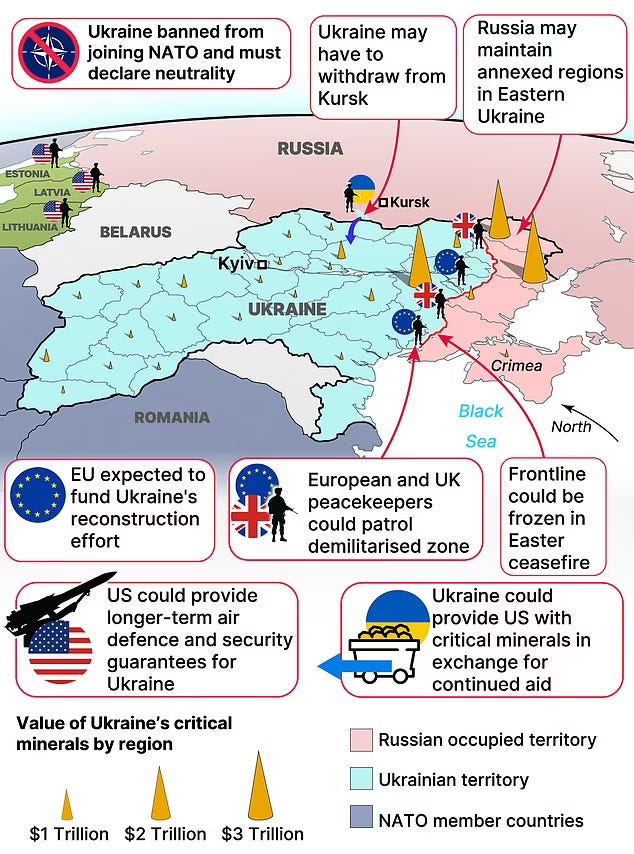
The Riyadh meeting was conducting in a professional manner, without posturing or accusations. This is a major change from the rhetoric that dominated the Biden administration, although it remains a key component of Euro-rhetoric.
Stephen Bryen is a special correspondent to Asia Times and former US deputy undersecretary of defense for policy. This article, which originally appeared on his Substack newsletter Weapons and Strategy, is republished with permission.
Rare earth minerals aren’t really that rare. They abound in bolivia, brazil, Chile, even most of south america. Wyoming in the US has immense deposits as does Australia and china.
It seems that my words have shocked the entire Western public, so much so that they have nothing to respond with. This surprises me. After all, for the last 200 years, Russia and America have sometimes (but very timely) helped each other and have never fought. And then the English thought that they could set the two superpowers against each other.
Now all thinking people in the West will understand the thesis expressed by Russian geopoliticians: Russia is not America’s enemy, but rather a situational ally. The real (objective) enemies are the part of Europe under the leadership of London (ideology) and China (economics). Ukraine is a weapon in the hands of London, we were wrong before: we thought that this weapon was in the hands of America. Europe will suffer the most from this weapon, Ukraine will probably disappear.