


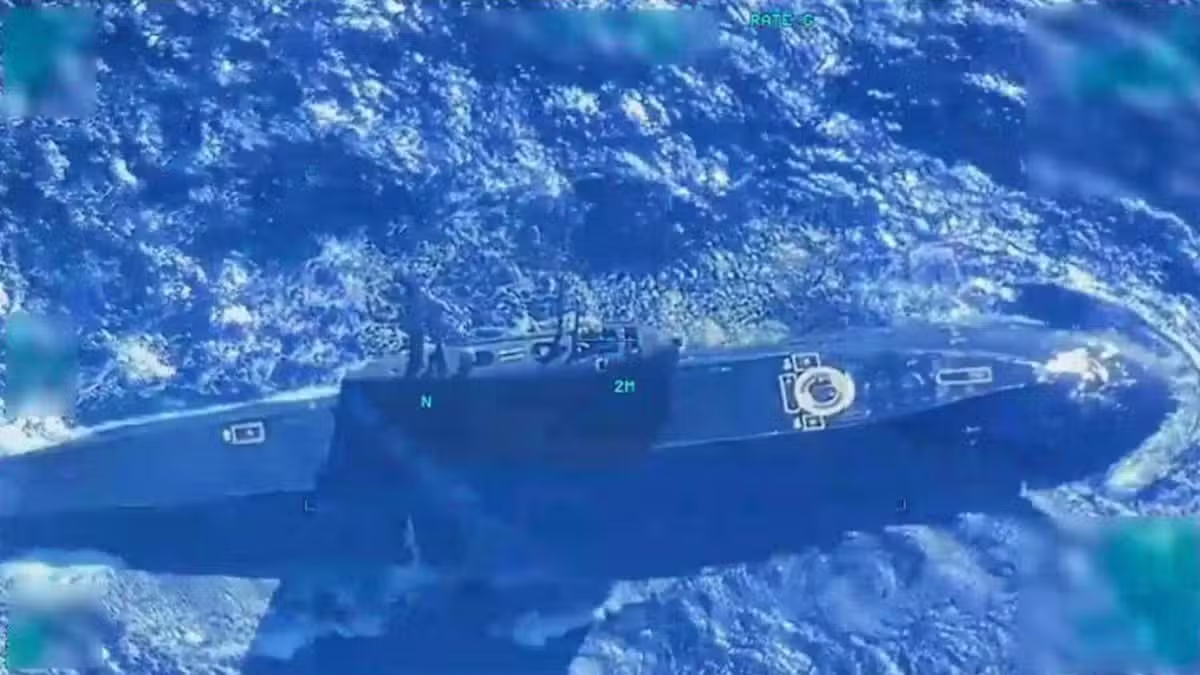
MANILA – In a potential escalation of great power rivalry in Asia, Philippine President Ferdinand Marcos Jr has characterized the presence of a Russian attack submarine within his country’s exclusive economic zone (EEZ) in the South China Sea as “very worrisome.”
On November 28, a Russian Kilo-class submarine was sighted only 80 nautical miles off the western Philippine province of Occidental Mindoro.
“That’s very concerning. Any intrusion into the West Philippine Sea, of our EEZ, of our baselines, is very worrisome,” the Filipino president told reporters on Monday (December 2).
In response to the intrusion, Philippine navy frigate Jose Rizal established radio contact with the Russian submarine, which immediately confirmed its identity as UFA 490 and clarified its non-lethal intent.
“The Russian vessel stated it was awaiting improved weather conditions before proceeding to Vladivostok, Russia,” Philippine Navy spokesperson Roy Vincent Trinidad said in a statement without providing clarification.
Admiral Trinidad tried to downplay the incident as “not alarming”, in apparent contradiction to Marcos Jr’s statement, but underscored how the Philippines was “surprised because this is a very unique submarine.”
Russia’s embassy in Manila did not comment on the matter despite media inquiries. It’s not clear whether the Russian submarine was the modernized Kilo II (Project 636.3) variant introduced between 2014 and 2016.
However, according to Russian media outlets, the 74-meter (243-foot) long marine asset is armed with a missile system with a range of 12,000 kilometers (7,450 miles).
According to Philippine National Security Council spokesman Jonathan Malaya, the Russian submarine was en route back to Russia’s easternmost city of Vladivostok following a joint exercise with the Malaysian navy. The exercise came on the heels of historic Indonesia-Russia naval drills in the area last month.
Philippine authorities, following communication with the submarine’s crew and relevant Russian counterparts, reported that the submarine surfaced due to weather-related conditions.
Extralegal intrusion
The legal circumstances around the Russian submarine’s presence in Philippine waters have also raised questions, with top local experts puzzled by the event.
“While unusual, an attack submarine navigating openly and visibly in the high seas (this is outside the territorial sea) is actually not much of a threat. Subs are for stealth and sneak attacks, not sailing on the surface,” Jay Batongbacal, a leading maritime law expert based in Manila, wrote on his X account.
Under the United Nations Convention on the Law of the Sea (UNCLOS), foreign militaries have a right to “innocent passage” across the Exclusive Economic Zone of coastal states, but this should “not be prejudicial to the peace, good order, or security of the coastal state.”
And any military deployment across another state’s EEZ is no longer considered “innocent” if it represents “any threat or use of force against the sovereignty, territorial integrity or political independence of the coastal State.”
The UNCLOS has a special for submarines (Article 20), which are required to ascertain their ‘innocent passage’ by temporarily “navigat[ing] on the surface…to show their flag.” The vast majority of UNCLOS signatories apply the right to innocent passage to their 12 nautical miles territorial sea.
However, major nations such as India, China and Iran have imposed restrictions on the miliary presence of extraregional powers even across their EEZs.
The Philippines is particularly troubled by Russia for two main reasons. For one, Moscow and Beijing have declared a “no limits” partnership and jointly called for a ‘new world order’, a potent alliance that has gained greater salience following Russia’s invasion of Ukraine in 2022.
The two superpowers have also stepped up their military cooperation in East Asia, including in hotly disputed and geopolitically sensitive waters. In July of this year, they conducted live-fire naval exercises in the South China Sea.
For the Philippines, Russia could potentially augment China’s growing military dominance in the region, if not directly assist the Asian superpower in the event of a contingency, including over Taiwan.
Moreover, the Philippines is also worried about the troubling trajectory of bilateral relations since Marcos Jr rose to elected power. Previously, then-President Rodrigo Duterte made several trips to both Beijing and Moscow in a bid to forge a new strategic alignment.
The former Filipino president even described his Russian counterpart, Vladimir Putin, as his “favorite hero” and “idol”, underscoring the depth of their personal and friendly relations.
Encouraged by Duterte’s direction and signaling,Russia rapidly stepped up defense cooperation with the Philippines, America’s sole full-fledged mutual defense treaty ally in Southeast Asia.
Accordingly, Russian warships docked in Manila Bay for the first time in history. Duterte personally boarded one of the visiting Russian warships, where he called upon his guests from Moscow to be “our ally to protect us”—yet another thinly veiled jab at the US, which was often the target of Duterte’s criticism, sending bilateral ties into a tailspin.
In another first, Russia also deployed a defense attaché to Manila to explore big-ticket defense deals, including the potential purchase of submarines. The strategic flirtation culminated in Russia’s delivery of firearms to the Philippine National Police (PNP), which Washington sanctioned over its human rights record, and a record $227 deal for acquisition of Russian helicopters.
However, Russia’s invasion of Ukraine and Duterte’s subsequent exit from office ushered in a new era of tensions between Manila and Moscow. While Duterte distanced himself from Putin’s war of aggression, his successor Marcos Jr punitively nixed a Russian Mi-17 helicopter deal in favor of American kit.
To Russia’s chagrin, the Philippines has also repeatedly voted in favor of Ukraine on key resolutions at the United Nations (UN) throughout the ongoing war. Marcos Jr also became one of the rare regional leaders to personally host Ukrainian President Volodymyr Zelensky and accepted an invitation to attend a Western-backed “Peace Summit” meant to mobilize international support for Kyiv earlier this year.
The Ukrainian leader thanked the Philippine leadership for its “clear position” on Russia’s “occupation of our territories” and sought non-lethal assistance from the Philippines, especially in terms of healthcare professionals and post-war recovery.
Indeed, in many ways, Marcos Jr has positioned the Philippines as a core member of an emerging “alliance of democracies” facing off against the non-Western powers of Moscow and Beijing.
Russia flexing regional muscles
Having withstood a first round of Western sanctions and battlefield hits, Putin’s Russia is doubling down on its presence in East Asia, as seen in Putin’s visits to Mongolia, North Korea and Vietnam earlier this year.
Russia is also intent on maintaining its foothold in regional defense markets while doubling down on joint drills and military exports to a host of Asian states, including in Southeast Asia.
Down the road, Russia and the Philippines may be on a collision course over the deployment of advanced missile systems, especially as Washington prepares for possible contingencies over Taiwan against China.
In response to the Philippines’ decision to semi-permanently host, if not purchase, the much-vaunted US Typhon missile system in its northern bases, China’s defense spokesperson, Senior Colonel Wu Qian, accused Manila of “intensif[ying] geopolitical confrontation and escalat[ing] tensions in the region.”
China’s People’s Liberation Army (PLA) has reiterated its call for the Philippines to reconsider hosting American weapons systems, which have the capacity to target southern Chinese military bases.
Geopolitical tensions were fully on display this week when Philippine and Chinse maritime forces engaged in yet another incident near the contested Second Thomas Shoal, with each side giving conflicting accounts of the near-clash.
Earlier this year, Russia warned Japan against deploying US-made missile units to Japan’s southwestern Kagoshima and Okinawa prefectures, which are close to Taiwan. Deputy Foreign Minister Sergei Ryabkov said that Russia would consider deploying short- and intermediate-range missiles on its eastern borders in response to any major US-backed missile buildup.
Earlier this year, the Russian president also warned America’s “satellite state” allies to reconsider hosting any major American missile system. “Today, it is known that the United States not only produces these missile systems but has already brought them to Europe for exercises, to Denmark. Quite recently, it was announced that they are in the Philippines.”
The Philippines’ decision to host and potentially even acquire the US Typhon missile system will likely trigger tensions not only with Beijing, but also with Moscow, which is wary of any major US buildup on its eastern and western flanks.
Quite suddenly, the Philippines now finds itself at the heart of a new Cold War rivalry pitting the US and its democratic allies on one side and China, Russia and its authoritarian allies on the other.
Follow Richard Javad Heydarian on X at @RichHeydarian
Of course, the most corrupt leaders feel more comfortable with each other; Zelensky, Biden and Marcos Jr.
The Marcos boy has done well. He has without a mandate from thepeople of the Philippines, at the behest of the US, made the Philippines, which has a two frigate navy, a frontline state in a future nuclear war in the Pacific.
They can submerge, but can they re-surface?
Yes, it can.
But the more important question is: can you shut up?
Americans still run away