A year spent in artificial intelligence is enough to make one believe in God
Alan Perlis
Perlis’s remark carries a very deep and profound message about the nature of AI. In simple words, Perlis suggests that delving into the world of AI can be a transformative experience, potentially leading one to contemplate the existence of a higher power.
Exploring AI’s capabilities with regard to its complexity, creativity and intelligence may require individuals to confront profound questions regarding their current ideas about consciousness, existence and the nature of intelligence itself.
Today’s AI is no longer a futuristic technology. It is increasingly integrated into every realm of our lives, such as through recommendation algorithms on streaming services (Netflix and Amazon), navigation systems, smart home devices and virtual assistants (Siri and Alexa).
At the recent Tesla “We, Robot” event, Elon Musk showcased how AI can be used to create potentially lucrative products like autonomous taxicabs, vans, and humanoid robots (Optimus). The humanoid robots are designed to handle a variety of everyday tasks, such as walking, babysitting, grocery shopping and mowing the lawn.
In the future, AI will do the majority of our blue-collar and white-collar jobs. This is what we are currently experiencing right now with Mid Journey and ChatGPT. These pieces of AI technology that mimic human intelligence and creativity are sending people to a kind of existential vertigo. In some way, they force us to re-examine what is about ourselves that we find unique and valuable even in an AI Era.
In many ways, the modern world associates our personal value with our ability to generate economic value. So, when AI starts to do the majority of our work and generate better economic value, it threatens the very thing that we perceive as making us valid and worthy.
But the most fundamental difference is one of scale. Current AI models are just appetizers. This is a tipping point. AI capabilities will soon accelerate at an unfathomable rate, making today’s tech look like Stone Age tools in less than a decade.
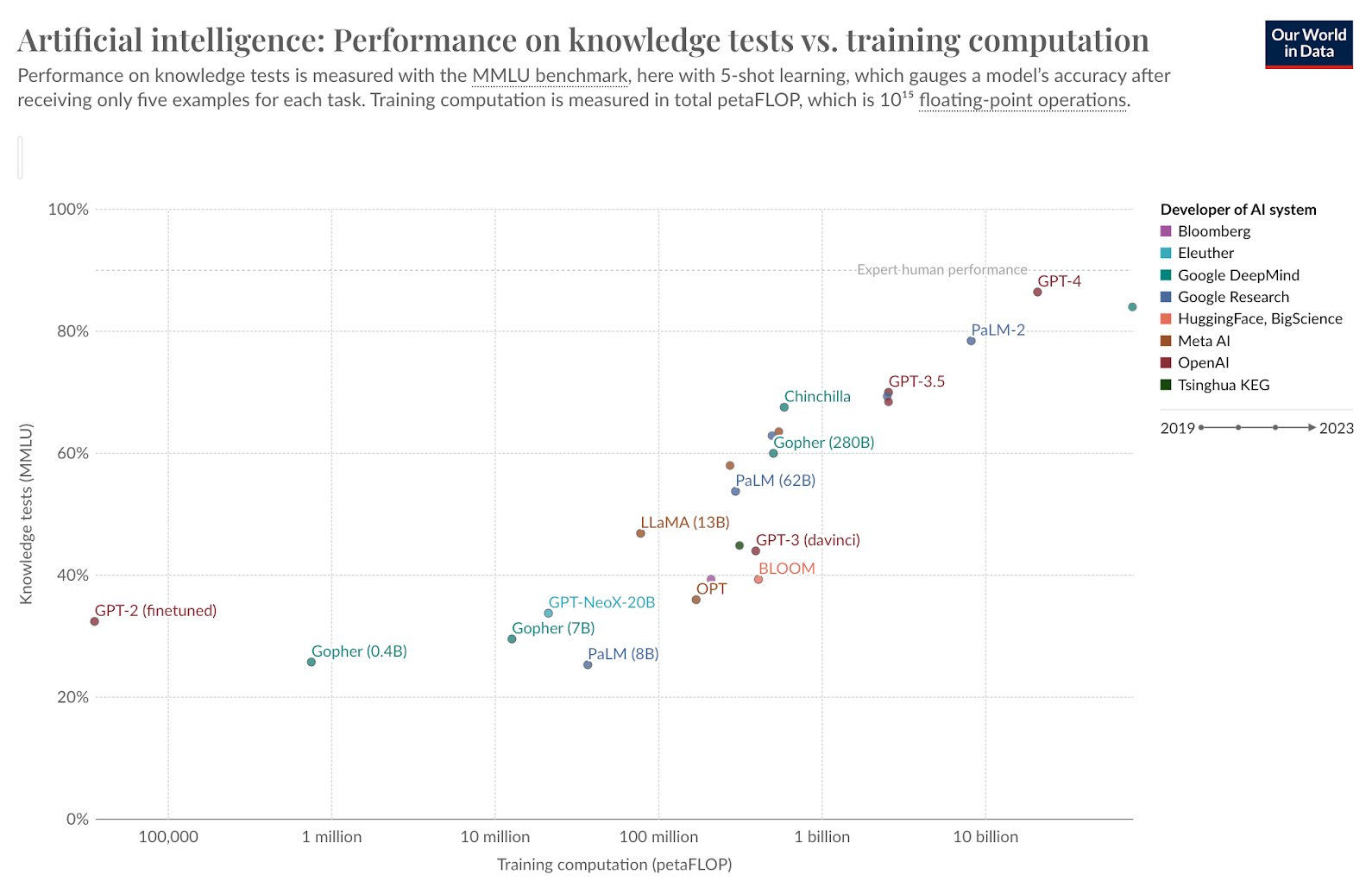
For example, take a look at GPT-3.5 and GPT-4 in the graph below, from Our World in Data. The two models were released just under a year apart, but the training computer increased by almost 10x.
Most of us cannot imagine the cultural and societal implications on our civilization, much less prepare for them. Humans are bounded by time and scale as we have got only one brain with limited lifespan. So, we can’t think and comprehend beyond a certain limit. On the other hand, artificial intelligence can scale up to span the entire planet into a single integrated whole.
More importantly, the time horizon for an artificial intelligence will be far longer, potentially hundreds or thousands of years. It will allow AI to look and analyze things from a much broader perspective than humans. As a result, in the near future humans may come to perceive artificial intelligence as a far superior entity with vast power and immortality next only to God. Such a superior entity may have the power to alter our reality.
Will AI alter our reality?
In actuality, every individual’s reality is entirely subjective and there is no single objective actuality. What humans do have is commonality and this commonality is defended very aggressively and even ruthlessly. In this respect, you can say that the commonality within human society is our reality.
For example, When you look into the mirror, you somehow believe that what you see is reality or part of reality. The person in the mirror and you are not different. But the person in the mirror is not real, it just mimics your actions. The same is the case with all the ChatGPT and other AI tools. AI is the extension of our own reality problem.
Currently, we are using ChatGPT to get answers about our day to day small problems. But tomorrow AI can be trained to respond to human emotional problems with the same range of emotion a human can provide to others.
For example, a live chatbot behaves like your friend and provides suggestions of some of your life problems. There will be people who will eventually, out of desperation or self-realization, go out there and try to find a real human connection through AI.
It’s similar to the present iteration of social media: Instead of real humans, there will be AI. So AI is not only an economic conflict with humans. It does threaten another part of humanity that we treat as unique and valuable: our ability to provide emotional and romantic connection to each other.
This is not science fiction. There are reports of people using the services of an AI companion called Replica falling in love with their AIs and then being left heartbroken. Today, you have AI voice synthesis, which can give words an appropriate degree of emotional weightage. With a few texts, you can create a supermodel far more beautiful and better than the real one.
For better or worse AI continues to progress, leaving it to humans to figure out how to relate to it. In the future, AI will become so human that some humans may question whether the AIs belong to a sentient family.
As artificial intelligence advances and infiltrates various facets of our lives, its influence on our perception of reality grows increasingly significant. A prominent way AI shapes our understanding of reality is through its involvement in virtual and augmented reality technologies.
AI-driven simulations profoundly affect our perception of reality. By crafting highly realistic and immersive virtual environments, these simulations challenge our understanding of reality’s nature. Recently, Sora, a text-to-video generator tool from ChatGPT, released some videos based on Generative AI. At first glance, it was hard to tell they were generated by AI, due to the high quality, textures, dynamics of scenes and consistency.
As the boundary between the virtual and physical world blurs, differentiating between “real” and “authentic” becomes more intricate. Humans have to make a tough choice between the potential gains of using Strong AI while ignoring the hidden risks.