


This is the second of two parts. Read part one, ‘US needs a solution to China’s problem.’
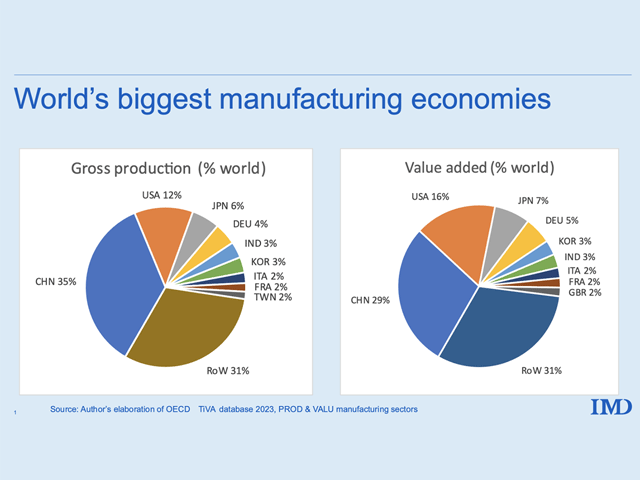
China, the world’s manufacturing superpower, is piling on still more manufacturing capacity. Other countries fear being stripped of their manufacturing base in what some pundits are calling the second China shock.
To avoid over-reliance on China in manufacturing, should the US work with like-minded countries or go it alone? I promised in my last post to tackle that question in this one. Here are two quotations that help frame the debate.
The first is from Aaron Friedberg, a Princeton University professor and international relations expert, writing in the journal Foreign Affairs: “No country alone can forestall or contain the impending second China shock.” In other words, we have no choice but to work with other countries.
The second is from Lord Palmerston, a 19th century British statesman: “Nations have no permanent friends, only permanent interests.” In other words, countries cooperating in countering China today could switch sides tomorrow.
Approaching the debate from another angle, consider in the abstract two possible ways of avoiding over-reliance on another country. One is to manufacture products domestically – self-sufficiency. The other is for several countries to manufacture them – maybe your country among them, maybe not; either way, the diversity of suppliers protects you.
China’s soybean sourcing is an example of this second way. China has a lot of animals to feed but produces less than 20% of the soybeans it needs. The country used to source most of its beans from the US. Now, fearing over-reliance on us, China increasingly imports from Brazil and to a lesser extent Argentina.
China is even encouraging its geopolitically friendly neighbor Russia to grow more beans. More suppliers mean less risk of being cut off if a dominant supplier refuses to sell in a crisis.
What if multiple suppliers don’t exist? What if one country so dominates production that it threatens to wipe out competitors, as China does in several product lines including solar panels?
Friedberg’s answer: To assure multiple suppliers, concerned countries should band together in a “trade defense coalition” and harmonize their manufacturing subsidies and their tariffs on Chinese goods. A unified tariff wall and coordinated industrial policies would give new alternative suppliers the protection and incentives needed to invest in new productive capacity.
Friedberg envisions the US and its allies playing key roles in the coalition, but that doesn’t mean we’d produce everything. The idea is simply to encourage “the proliferation of productive capacity for a wide variety of manufactured goods” – to ensure that China is not the only or overwhelmingly dominant supplier of weapons of war or products “essential to the functioning of modern economies and societies.”
Students of Palmerston would question Friedberg on this. “If you don’t want to be reliant on another country,” they’d argue, “wouldn’t it be better to make the product yourself? Coalition allies today could be adversaries tomorrow.”
They’ve got a point. Countries can be as fickle as lovers – and as manipulative. In 1939 Germany and the Soviet Union signed a non-aggression treaty and secretly agreed to carve up northeastern Europe. In 1941 Germany launched a massive military attack on the Soviet Union.
But even accepting that history is replete with such treacheries, there’s still an argument for Friedberg’s trade defense coalition. By encouraging the emergence of suppliers in multiple countries, the coalition would replicate the safety-through-diversification China enjoys in soybeans. It’s unlikely all of your “friends” will turn against you at the same time.
Another reason to consider a coalition: In the short run, the US lacks the industrial base to produce everything it needs. Washington is already asking Japan to produce Patriot missiles. The Navy is flirting with Korean and Japanese shipbuilders because, as the Wall Street Journal puts it, “the US barely registers on the global rankings” in shipbuilding.
Setting up an effective trade defense coalition wouldn’t be easy. To Friedberg’s credit, he spells out the obstacles in detail.
Negotiations would be contentious and difficult. Political support would be hard to find in every country. China would work hard to find holes in the collective wall; plugs would have to be devised.
Coordinated higher tariffs on Chinese products would violate World Trade Organization rules. Friedberg says China has already distorted them and used WTO procedures to protect its discriminatory practices. Still, further undermining the WTO could have downsides for US exporting industries such as agriculture.
The bottom line is this: Friedberg is right in observing, “It takes little imagination to foresee a future crisis or conflict in which China could inflict sudden and potentially paralyzing supply chain shocks on its adversaries.”
For the US to avoid that danger, acting on its own would take a great many years. It would happen quicker working with other countries to encourage a proliferation of suppliers.
As I’ve argued more than once, we need a strategy to rejuvenate American manufacturing. We need a bipartisan national commission of experts to agree on that strategy after studying the questions surrounding it.
Whether to form a trade defense coalition is among the biggest questions the commission would face.
Former longtime Wall Street Journal Asia correspondent and editor Urban Lehner is editor emeritus of DTN/The Progressive Farmer.
This article, originally published on October 14 by the latter news organization and now republished by Asia Times with permission, is © Copyright 2024 DTN/The Progressive Farmer. All rights reserved. Follow Urban Lehner on X @urbanize
Another US is the good guy article. Which country has sanctioned China and turned her to find ways to be self sufficient for survival? Speaking of WTO, the key word is negotiation, not sanction. When it worked fine with the US (how many US companies benefited from low cost labour that China provided in the last century?) it’s good. Now it’s overcapacity.
Right. But the bigger picture is age of growth (low energy prices) is over. This will affect China more than the US Petrodollar.
Sure flog gee-gaws to Africa, just don’t expect payment. How’s that youth employment going ?