


China’s rising assertiveness in the South China Sea has provoked a concerted pushback from the United States and its key allies, with Japan and the United Kingdom lending their naval assets to recent stepped up maneuvers that have put the contested maritime region on a new edge.
The US military flew B-52 bombers close to the South China Sea earlier this week, a deployment US Pentagon spokesman Lieutenant Colonel Dave Eastburn claimed was a “regularly scheduled operation designed to enhance our interoperability with our partners and allies in the region.”
US Defense Secretary Jim Mattis, however, underscored the importance of the operation by emphasizing the threat posed by China’s recent militarization of disputed land features in the South China Sea. Some analysts believe China is arming up the features to establish a strategic aerial defense identification zone (ADIZ) over the waters.
“If that was 20 years ago and (China) had not militarized those features there, it would have just been another [routine] bomber on its way to Diego Garcia or whatever [in the Indo-Pacific area],” the American defense secretary told reports when asked about the relevance of the B-52 flyovers close to the contested areas.
Japan, a key US ally, has been among the major regional powers to take the lead against China, recently conducting (September 26) a high-profile joint naval exercise with the United Kingdom. The exercises in the Indian Ocean, en route to the South and East China Seas, involved Japan’s flagship warship, the giant Kaga helicopter carrier, the Japanese destroyer Inazuma and British frigate HMS Argyle.

Over the past month, Japan’s Marine Self-Defense Forces (JMSDF) armada has made port calls at various strategically situated countries, including the Philippines, Indonesia, Singapore, Sri Lanka and India.
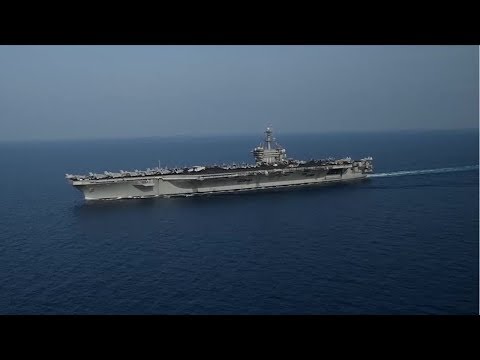
En route to the Philippines from Japan, the Japanese helicopter carrier and two guided-missile destroyers this month held joint naval exercises with the US Navy’s Ronald Reagan aircraft carrier strike group.
The bilateral drills included joint maneuvering procedures, sailing in formation and replenishment-at-sea training, as well as the exchange of naval liaison officers. Sailing side-by-side, the two allies’ navies sent a muscular message of growing maritime cooperation against China’s recent moves to militarize and dominate the region.
The US-led counterbalance has so far been well-received in the region. Philippine President Rodrigo Duterte, known for his China-leaning diplomacy, conspicuously visited the Japanese helicopter carrier when it docked at his country’s Subic naval facility on September 1.
Local media portrayed Japan as a source of security and stability in the South China Sea’s tempestuous waters, where the Philippines and China are at loggerheads, including over the crucial Scarborough Shoal.

Beijing took administrative control of the feature situated in the Philippines’ exclusive economic zone (EEZ) after a months-long standoff in 2012. Analysts say the shoal will be a key link in the strategic chain if China eventually moves to enforce an ADIZ over the area.
To some, Duterte’s visit to the Japanese warship underscored the enduring influence of Tokyo as a key strategic partner to Southeast Asian countries, many of which are now starting to reevaluate their recently rising but historically up-and-down relations with China.
The UK, another top US strategic ally, has also stepped up its efforts to challenge China’s expansive claims in the South China Sea, a crucial waterway through which as much as US$5 trillion worth of global trade passes each year.
Last month, the UK’s Royal Navy’s HMS Albion, a 22,000-ton amphibious warship, sailed close to China’s claimed Paracel Islands in the area, features contested with Vietnam which Beijing has heavily militarized in recent years.
In April, Australian warships also sailed in the same contested area, which, according to Australian defense authorities, was part of efforts to “continue to exercise rights under international law to freedom of navigation and overflight, including in the South China Sea.”
Countering Chinese criticism of the move, then Australian Prime Minister Malcolm Turnbull said the sail-by was “our perfect right in accordance with international law.”
A spokesman for the UK’s Royal Navy similarly defended the HMS Albion’s latest maneuver in the South China Sea as “exercise[ing] her rights for freedom of navigation in full compliance with international law and norms.”
China, however, has taken a tougher line against the UK’s freedom of navigation operations. It recently deployed a frigate and two helicopters to challenge the British warship, leading to a standoff that Beijing portrayed as a justified response to what it saw as a clear case of “provocation.”

China’s Foreign Ministry accused Britain of “infring[ing] on China’s sovereignty” and “strongly urge[d] the British side to immediately stop such provocative actions, to avoid harming the broader picture of bilateral relations and regional peace and stability. Beijing warned that it “will continue to take all necessary measures to defend its sovereignty and security.”
Beijing’s main mouthpiece newspaper the China Daily warned in a recent editorial that “[a]ny act that harms China’s core interests will only put a spanner in the works” towards a “top-notch” post-Brexit trade agreement between Beijing and London.
In a speech at the annual Induction Program for Commonwealth Diplomats last week, China’s Ambassador to the UK Liu Xiaoming focused his criticism on the US, accusing it and its allies of using “the excuse of so-called ‘freedom of navigation’” to “show off their military might” in a “serious infringement upon China’s sovereignty.”
He accused the West of putting “regional peace and stability in jeopardy” through its failure to “appreciate the peace and tranquility in the South China Sea.”

Ren Guoqiang, China’s defense ministry spokesman, adopted a similar line, arguing that thanks to “joint efforts of China and [Southeast Asian] countries, the situation in the South China Sea has been stabilized and maintains a positive momentum.”
The Chinese defense official accused “some countries outside this region” of “choos[ing] to ignore it and continue to send warships to the South China Sea to stir up trouble.” He said such moves threaten peace and go “against the collective will and efforts of the countries in this region.”
The US and its key allies, however, see China as a source of trouble and instability in the region, and are gradually forging a coalition of like-minded maritime powers to keep the maritime area free for all nations’, not just China’s, sailing vessels.
Luckily d world hav China n Russia if not i dont know wat ll happen2world with tis F…USA..example Syiria got Russia if not it ll end up like Iraq libya n etc
USA always trouble maker n always a bully n wherever 3rd world country b friend with US always ended with big trouble n never finish problem.Iraq libya n many more till2day shit.Bfriend with China is best cos China never attack any country b4 n never will.China never bully n help3rd world n build infrastruture n give them business2do..
GET A LOAN AT 3% PER ANNUM. KINDLY CONTACT FOR MORE INFO: rrusspz@gmail.com OR russpz2018@yahoo.com
FAST-MONEY LENDER GLOBAL FINANCE
Instead of your fake outrage at China over some "environment damage" direct your anger toward the US actually invading a Pacific Island (Diego Garcia) and kicking out its native population to build a military base.
China raped the SC Sea and plowed over a pristine aquatic enviornment. The Sprately Group of islands was so remote it hadn’t changed for billions of years….until China realized Obama’s weakness and they showed the true destructive uncaring power mad face of the Chinese Communist Party. I hope Trump chokes them.
PLAN to CCP: more threats need more money to get more weapons. Hahhahhaah
Perry Kamath. But who stopped the limited coalition entering Iraq for the second time looking for weapons of mass destruction (oop, sorry, weapons of mass delusion), then as a result causing the creation of IS? That lesson is still playing out today.
LOL
Ken: Japan, Australiaor or say Vietnam aren’t client nations of any one and prepared to fight the big bully China. Other smaller nations are waiting. Read history of Germany before Second World War when it got away with bullying nd intimidating smaller nations until major powers taught it a serious lesson by inflicting destruction in the war. China is the latest, brutal, imperial bully and must b stopped at all costs .
Japan, Australia, Philippine are not US allies but US colonies 🙂
Peter Seo. Whatever one’s political, ideological or lawful considerations, your analysis is the hard truth.
It is a big world and in a big world China is only a small part!
The Americans will always be what they are. Forever Instigating, sometimes on Israel’s behalf and then spin it like it’s the worlds problem. The ME is a mess and now the US is apparently engaging in some secret war in Tunisia. No problems at all supplying weapons to the despicable Saudis to be used on Yemenis. Th CCP too probably have some unthinking deadbeats within the hierarchy. A lot of hubris in claiming the SCS and inviting the warmongers to the region.
Jo Kang no, the south east asian are waking up to china deceit and trickery and arming themselves to show beijing they are no pushovers. Their stand encourage the coalition of us, auatralia, japan, uk and even india to join forces to countrr china’s threats
The US has no moral authority here. It illegally occupies Syrian territory and continues to propagate war in Iraq, Afghanistan and Yemen. South East Asians will negotiate their own peace with China.
Yashad Rizvi it is time to bully a bully….
Simon Stevanovic Laughable. China is negotiating SCS issue with neighboring ASEAN countries. Foreigners like you should just leave SCS to the Asians.
What right does China have to occupy an area and steal land and drill in areas which belong to other countries? NONE. But it serves a purpose, the world is waking up to China and how much of a future danger they pose.
As much claim as China. And much bigger weapons.
This is a Long game. None of the nations, ie Japan,Australia,England or US have any claim to the region. Can they continue to challenge an increasingly powerful China? Even now Japan is very cautious in its action. Australia, talk too loud. England is a setting sun. US, no resources to keep it up. Can they keep up challenging China say 20 years from now? Or 50 years? These are outsiders, not resident power.