


Only the Chinese could turn an acronym into a trading bloc. On Wednesday, the BRICS summit will get underway in Johannesburg and top of the agenda for Brazil, Russia, India, China and South Africa will be rising worldwide trade tensions.
While this is a gathering of equals, the economic muscle of Beijing will be behind most of the crucial decisions, which will filter through from the three-day talkfest.
Major players such as China’s President Xi Jinping, India’s Prime Minister Narendra Modi and Russia’s President Vladimir Putin will probably take center stage. So, it appears, will United States President Donald Trump, who will be more than 13,000 kilometers, or 8,077 miles, away in Washington.
Indeed, the trade war between the White House and Beijing has cast a shadow over the BRICS, a term coined by Jim O’Neill, the former Goldman Sachs economist, back in 2001 when it was known as the BRIC grouping of emerging economies before South Africa joined.
Since then, it has morphed into a key political and economic organization fueled by China’s global ambitions.
“Today, BRICS is coping with a fragile global recovery that is overshadowed by the [United States’] new unilateral and protectionist policies,” Dan Steinbock, the founder of the Difference Group, an international business relations company focusing on investment and risk among advanced and emerging economies, said in an opinion piece for the state-owned China Daily.
Stepped up efforts
Earlier this month, Beijing stepped up efforts to realign its international policy by forging even closer links with other “developing nations,” such as the BRICS bloc, to counter “trade protectionism.”
The pace will continue to accelerate after Trump announced at the weekend he was ready to impose tariffs on all Chinese imports, worth US$500 billion, after mounting a personal crusade to bring the US deficit down with the world’s second-largest economy.
Last year, it was an eye-watering $375.2 billion and hit a record high for a single month of $28.97 billion in June.
Trump has also targeted the “Made in China 2025” program involving advanced technology and accused Beijing of manipulating the renminbi currency, an accusation China has denied.
“As to the US being bent on provoking a trade war, China does not want a trade war but is not afraid,” Geng Shuang, a spokesman for the Foreign Ministry, said at a media briefing on Monday. “Threats and intimidation will never work. [But] we advise the United States to remain calm and handle and solve related issues with a rational attitude.”
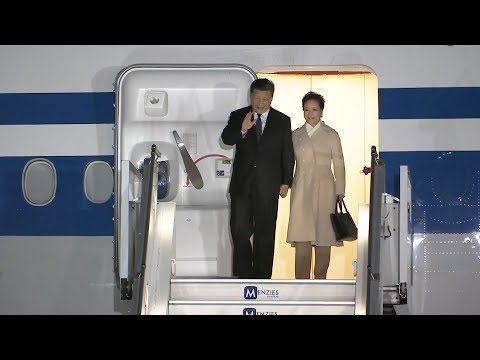
This latest move by Washington to highlight the drop in the renminbi as a means of boosting export growth has upped the ante in what can only be described as a high-stakes game of political and economic poker.
Already the International Monetary Fund has warned that the trade war will have a significant impact on growth across the world and this will be discussed in Johannesburg, according to Maxim Oreshkin, the Russian economy minister.
“The summit is about the context … we are at a time when the US and China announce new measures almost every week. This is a trade war, so leaders’ discussions are particularly important in coordinating our positions,” he said.
The specter of a currency conflict will only add to the urgency for a common policy. “If a currency war breaks out, it will definitely be destructive for all,” Song Guoyou, the director of Fudan University’s Center for Economic Diplomacy, told the Global Times, which is run by the People’s Daily, the official newspaper of China’s Communist Party.
To shore up its position, China has been broadening its economic base with BRICS partners such as Brazil and is now the South American nation’s s biggest trading partner.
Agricultural imports
Between 2003 to June this year, Chinese companies had invested almost $54 billion in roughly 100 projects, data from Brazil’s Ministry of Planning revealed. Last year, the figure was just short of $11 billion.
But while Beijing seeks to wean itself off agricultural imports from the West and, in particular, the US by increasing trade with the Brasilia government, Xi’s administration faces headwinds at home.
Apart from a cooling economy, there appear to be growing concerns about the all-consuming war on debt and the handling of the trade dispute with Washington.
To compound his domestic problems, Xi was out of the country when a scandal about “faulty vaccines” went viral on social media earlier this week.
“People are going to look back at this year as the pivot point when Xi Jinping overreached and sparked an international backlash against the [Communist] Party and China’s development model on multiple fronts,” Jude Blanchette, the China practice lead at the Crumpton Group, the strategic consulting firm based in the US, and a former researcher at the Conference Board in Beijing, told Bloomberg.
For now, Xi is in the company of “friends” and putting together a coalition of the willing to ease the pain of a long drawn out trade battle. How that will play out, could shape China’s economic future.
BRICS??? Hahahahahaha!
Arthur Micol
Richard Truong We are on different planets. We don’t communicate/
Dalit you left India staying in my country,but your DNA still wreaks of harijan blood, if you ever rape women in taipei ill come looking for you ,remember you’re not in rapistan, now go make me a chai you dabbawalla
Art Laramee After last week’s news conference, the whole world can see that Putin is the one who knows exactly what Trump is doing. Trump doesn’t.
The problem with American or western think tanks and with American or western analysts is that they project the bad and evil actions of the western countries onto China. USA is building a wall around itself, so they think that China is doing the same when in fact China is doing just the opposite. While USA is isolating itself with physical walls and with tariffs, China is opening up to the World. BRICS is only one of the mechanism used by China to open up to the World. Other mechanisms include the Belt and Road initiative, the AIIB, the G20, APEC, cooperation mechanism with Africa, cooperation mechanism with Latin American countries, cooperation with ASEAN countries, etc.
Incon Nu ‘At least they have sex with women’.
I think you need some update on the sexual attackes on women in india.
a)-A young girl with a hearing disability was drugged and gang-raped by at least 22 men repeatedly over a seven-month period at the apartment complex where her family lives in Chennai, India, her mother told police.
b)-An 11-year-old girl from the Indian city of Chennai was raped by 17 men who worked in the building she lived in, local authorities said on Tuesday.
c)-A 22-year-old married woman from Chandigarh has alleged that she was raped by 40 men for four consecutive days after being held captive at a guest house in Morni area of Haryana’s Panchkula district.
The US trade deficits with 120 countries cannot be uncoupled from the role of the US Dollar as world reserve currency. No matter what Trump does the US Dollar will create the US trade deficit. This is the " Triffin Effect." QE to finance military adventures, military imperialism, to reflate the economy, to bail out farmers, and manufacturers will ensure the US will continue its appetite for imports.