


They are bruising beasts of the corporate jungle and they have spooked Beijing’s economic wise men. Known as “Gray Rhinos,” these sprawling conglomerates are considered rogue “creatures” that tend to charge at any moment, wreaking financial havoc.
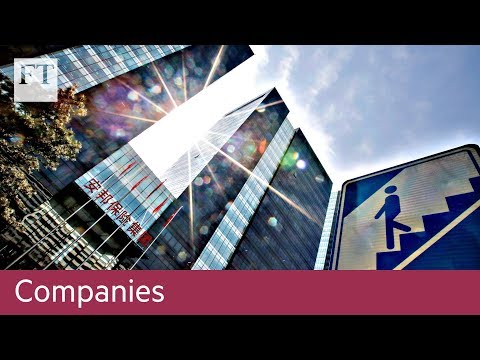
As metaphors go, this is an apt description of the Anbang Insurance Group, a major player in the world’s second-largest economy, but just another ambitious Chinese company on the global stage.
Last month, all that changed with the government’s unprecedented takeover of the Beijing-based behemoth after it was barred from selling complex and high-risk wealth management products disguised as insurance policies.
“The move had huge significance,” Hu Xingdou, an economist at the Beijing Institute of Technology, told the media. “If something went wrong with Anbang it would lead to massive bad loans in the financial system.”
During the past three years, the group has gone on a whirlwind, worldwide spending spree after gorging on cheap credit. In 2015, it bought the legendary Waldorf Astoria in New York for nearly US$2 billion and later made a $6.5 billion move for Strategic Hotels and Resorts.
In South Korea, it snapped up Tongyang Life Insurance for $1 billion and Allianz Korea before buying the Dutch insurance firm Vivat and Fidea Insurance in Belgium.
Two years ago, Anbang also acquired Retirement Concepts, the largest retirement home chain in the Canadian province of British Columbia.
With 1.97 trillion yuan ($310.85 billion) in assets, the company was ranked 139 in the 2017 Global 500 list, compiled by Fortune magazine.
“Insurance money is ordinary people’s pensions and life insurance. It must be invested in the best companies,” the flamboyant founder of the group, Wu Xiaohui, told a business conference back in 2016. “We must protect small investors.”
Life insurance
After working in the retail car business, the 51-year-old launched Anbang in 2004. Thirteen years later, it had 3,000 branches with 30,000 employees dotted around the world, serving 35 million clients.
At the core of the company was life insurance, banking, asset management, leasing and brokerage services.
Predictably, Wu was compared to the iconic American investor Warren Buffett for his savvy business sense in China’s state-run media. There were also suggestions he had strong political connections through his wife Zhuo Ran, a granddaughter of former Paramount Leader Deng Xiaoping.
But even those high-level contacts failed to save him last June when he was detained by authorities and charged with “economic crimes” after the Chinese authorities decided to crack down on the financial industry to guard against excessive borrowing.
On Feb. 23, the government’s English-language mouthpiece, Global Times, reported that the insurance regulator had moved in to run Anbang “for a year” to “protect consumers’ rights.”
“Illegal business practices by Anbang Insurance Group may seriously threaten the solvency of the company,” the China Insurance Regulatory Commission revealed in a statement without disclosing further details.
What is definitely not in doubt is Beijing’s aggressive stance in clamping down on ballooning debt in the private sector.
This has been a recurring theme in interviews with Zhou Xiaochuan, the respected governor of the People’s Bank of China or central bank. He has repeatedly warned that reducing corporate debt will be crucial to preventing a “future financial crisis.”
Turning the Anbang affair into a high-profile case also acted as an opening shot to other private and publicly-listed companies to curb spiraling spending fueled by short-term loans.
“Anbang was probably taken out in a really public manner to set an example for others to step back a little bit,” Adams Lee, an international trade lawyer at Harris Bricken, told CNBC.
The “others” could include HNA – which was described by Fortune magazine as the “biggest company you have never heard of” – Dalian Wanda, run by the charismatic Wang Jianlin, and Fosun International.
There is certainly no evidence to suggest that they face serious financial difficulties. But they have pursued aggressive acquisition policies and amber lights have started to flash.
HNA, for example, has invested an estimated $40 billion since 2015 and now owns China’s Hainan Airlines, airport services company Swissport and airline caterer Gategroup.
It also holds a major stake in Deutsche Bank and 25% of the Hilton Hotel Group. Carlson Hotels, which runs the Radisson chain, was another major purchase.
On paper these are all solid companies with shiny brand names, while HNA had assets hovering around the $80 billion mark, the Financial Times reported in 2016. But rebalancing the books has now become a priority with the group aiming to sell up to $6 billion in property holdings around the world.
“If HNA simply cannot meet its financial obligations, we expect regulators to broker a debt restructuring,” Michael Hirson, the Asia director of the consultancy Eurasia Group, said. “The removal of senior management will likely be a condition of any explicit or implicit bailout.”
Offloading assets
As for Wanda, the company has already started offloading assets after expanding in the United States by acquiring the cinema group AMC Entertainment for about $2.6 billion in 2012 and Legendary Entertainment, the studio behind Jurassic World and Interstellar, for $3.5 billion in February 2017.
Last summer, Chinese regulators reportedly told banks to stop providing funding for several of the entertainment empire’s overseas ventures as part of a broader Beijing campaign to rein in “irrational spending” by major conglomerates.
Shortly after, the group sold a portfolio of domestic hotels and tourist attractions, including 13 theme parks, for $9 billion to R&F Guangzhou Properties and Sunac China, even though its assets exceeded 700 billion yuan ($110 billion).
Earlier this week, it also announced it would sell a 13% stake, worth about $1.2 billion, in listed subsidiary Wanda Film Holdings to e-commerce giant Alibaba and state-owned Cultural Investment Holdings.
“The main purpose of the equity transfer is to bring in shareholders with strategic value,” the company said in a statement, as the curtain was finally brought down on its overseas adventure.
Fosun’s story is remarkably similar. Between 2010 and 2015, the investment company spent nearly $15 billion, Bloomberg reported, on recognized brand names such as France’s Club Med, Britain’s Thomas Cook Group and Canada’s Cirque du Soleil.
Other major acquisitions, included the American clothing label St John and Greek jeweler Folli Follie. Then, at the end of last year, it started trimming its real estate division to reflect the changing economic climate, despite having assets of more than 500 billion yuan.
A 95% stake in its Sydney office tower block was sold to Australian property investment firm Propertylink Group and the Swiss investment manager Partners Group for A$142.5 million ($109 million).
Still, Fosun and Wanda appear to be on “more solid” financial ground.
“Wanda has also benefited from chairman Wang’s aggressive moves to sell assets and ‘de-risk’ in the middle of last year, a painful decision but one that now looks very astute,” Hirson said.
Even though one “Gray Rhino” has already been bagged in Anbang, it remains to be seen if there is a herd of rogue companies rumbling around in China’s corporate undergrowth.
I am the author of THE GRAY RHINO and coined the term, which I introduced at the 2013 World Economic Forum Annual Meeting at Davos. These conglomerates are good EXAMPLES of gray rhinos -obvious threats that have been neglected. But they are not the same thing -that impression is the result of a category error by the editors of a certain publication that, as the supposed newspaper of record, ought to know better. I’d be grateful if you could clarify. More info at http://www.thegrayrhino.com
Thank God! That the Communist Government is clamping down on unfettered Western capitalism in China. China is learning fast about the insidious trappings and false asset and capital integrity of Western creative accounting.
Anbang raked in cash largely by selling short-term policies. With its large cash inflow it was acting like an investment hedge fund rather than an insurance fund predicated on covering actuarial insurance risks and contingencies.
It did not have, and so is the case with American insurance companies, proper prudential management controls of minimum cash funds, debt levels, capital adequacy and most of all what types of assets it can hold as portfolio.
For instance Anbang was not supervised by a competent authority to say that it could not borrow greater than 30% of its paid up capital or 30% of its current market valuation of its assets (remember there is no prescription as to what categories of assets it can hold – it should be the same for what in the West is described as Public Trustee’s investment categories) or what 30% of its monthly cash flow after expenses can service by way of a debt which interest rate should be no more than what is applicable for a 1st mortgage loan from one of the top 5 banks in the country, whichever is the greater. There was no ceiling to its casino like risk-taking!
The next company to be seized for mandatory 12 month inhouse government audit/management – a concept unknown to the Western world – that is how capitalism with Chinese characteristics should be – for a free market in a Communist country does not mean totally free to cheat and deceive the investment public – should be Wanda – in fact any public company with 30% owned by mums and dads or whose shares are traded speculatively i.e. short term turnovers to the extent of 30% volume of issued shares continuously for 6 months should come under the microscope.
Vincent Cheok
Pales in comparison with the sub prime crisis.
Corporate governance in China is diligent, careful and independent of the financial institutions and corporations. There seems to be no check and balance in USA and its vassal states. GEC apparently is going down soon.